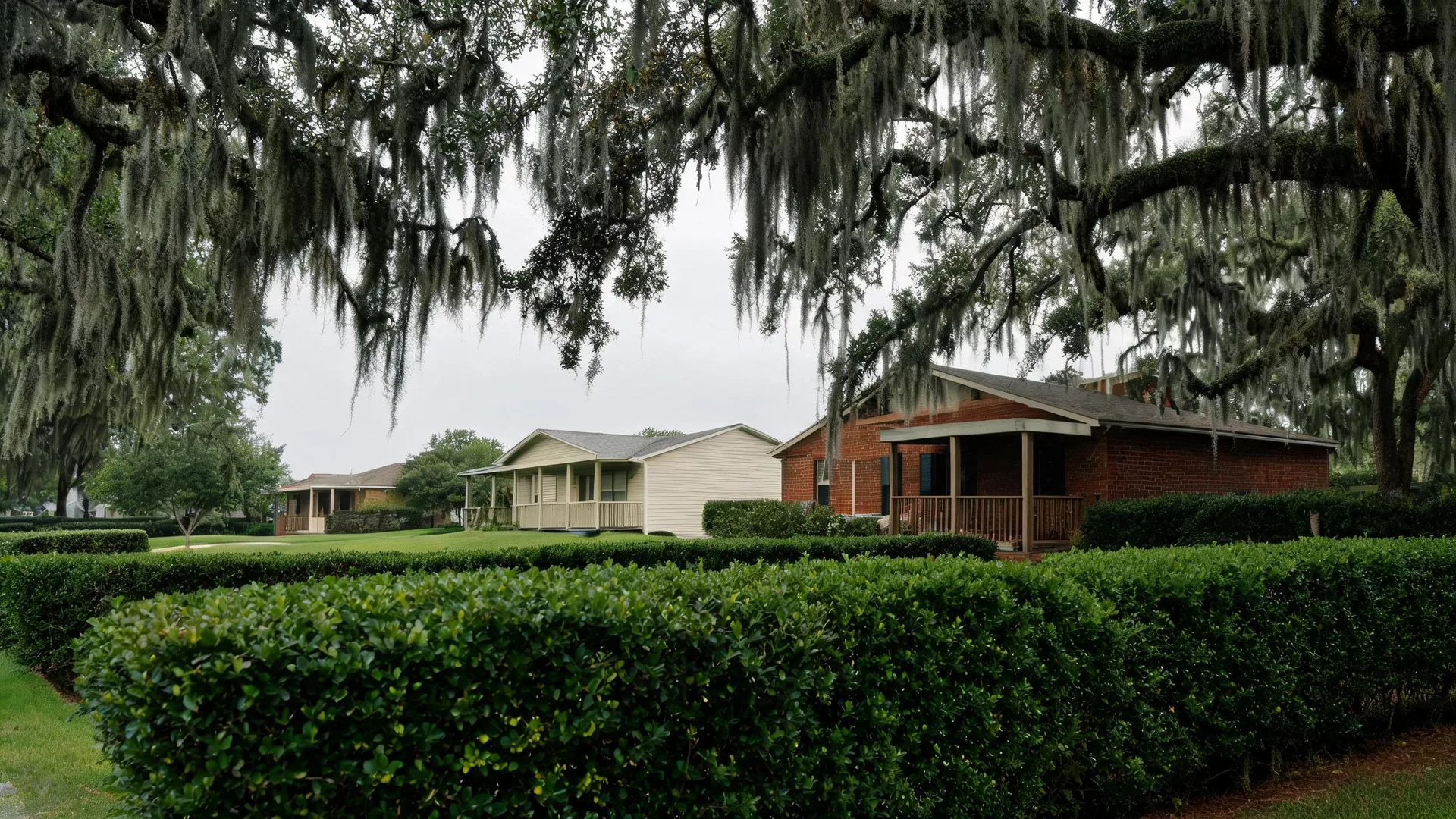





Single-story brick and white-sided houses behind a trimmed hedge and lawn, framed by overhanging oak branches draped with Spanish moss under an overcast sky.

Heat Pump Repair in Peachtree Corners, GA

Tell us about the job

Takes about a minute. No obligation.

RepairHeat PumpGwinnett County, GA
Step 1 of 2

What ZIP code is the job in?

Gwinnett County saw 185 severe weather events between 2015 and 2024. Most of that was wind, 143 damaging wind events, plus 20 hail events and a run of tropical storms and winter storms passing through. A heat pump's outdoor unit sits right in the path of all of it, exposed to hail and flying debris in a way a furnace tucked inside never is. Across Georgia, 31% of households lost power for a day or more in 2024, and a day without power means a day without heat or cooling, whatever the system. If your outdoor unit took a hit from hail or a branch, get it looked at even if it still seems to run fine. Bent fins and a cracked cabinet don't always stop a unit right away, but they tend to catch up with it.

6 months
November through April, your system heats
5 months
May through September, it cools
34°F
the average winter night it heats against
87°F
the average summer afternoon it cools against
Isometric cutaway illustration of a house showing interior ductwork, an indoor air handler unit, and an outdoor condenser unit beside the building.
Your system heats November through April and cools May through September.

NOAA nClimDiv, 1991–2020 normals

November is when heat pumps here switch over to heating and start working harder.

A weak part that made it through summer cooling often fails in those first cold weeks.

Half the homes here are new enough that repair still makes sense

Half the homes here were built by 1996
143 damaging wind events from 2015 to 2024
20 hail events from 2015 to 2024

Half the homes in Gwinnett County were built in 1996 or later. If yours is one of them, your heat pump probably isn't old enough to write off after one bad part. A repair makes sense on a system that still has years ahead of it. If the outdoor unit took wind or hail damage, that's one more reason to have someone check it now rather than wait for it to fail in the cold.

If your outdoor unit took a hit, get it checked before it has to work harder

A unit that took hail or a branch this year may not show it yet. Have it checked now, before cold weather asks more of it.

Find a contractor
A white mini-split heat pump outdoor unit mounted on a concrete pad beside a gray-sided house, surrounded by gravel and green shrubs.

A struggling part doesn't rest, it just gets worse

A heat pump doesn't get downtime the way an AC does. It runs for heat, then switches over and runs for cooling, so a part that's struggling never really gets a break to show you it's struggling, until it can't keep up anymore. A refrigerant leak is the clearest case. A system low on charge still runs, but the compressor works harder to move what's left, and it runs hotter doing it. Keep running it low and the compressor can wear out years before it should, turning a slow leak into a full replacement. A failing capacitor is similar. It can still kick the fan motor or compressor on for weeks, just slower and with more strain each time, until one start doesn't take and something else gets damaged trying to force it. Even something as simple as a dirty filter or blocked airflow compounds the longer it runs. Reduced airflow makes the whole system work against itself, and that shows up as frost building on the outdoor coil, where it has no business being outside of a scheduled defrost cycle. None of this means shut the system off and wait. It means a part that's already struggling doesn't fix itself by staying busy. The sooner a tech sees it, the more likely it's a part, not the whole unit.

The reversing valve is the part only a heat pump has

This is what switches the system between heating and cooling, and it fails in a couple of ways. It can stick in one position, so the system blows cold air when you need heat or won't cool when you need it. It can also leak internally, letting refrigerant bypass where it should flow, which shows up as weak heating or weak cooling even though the unit is running. A stuck valve is often a stuck solenoid, which is a smaller fix than the valve itself.
The defrost system fails quietly, then all at once

In heating mode, frost builds on the outdoor coil and the system needs to clear it on a regular cycle, using a sensor to tell it when to switch over and a control board to run that switch. If the sensor reads wrong or the board doesn't respond, frost keeps building instead of clearing. A thin coat of frost barely slows the unit down. A thick layer blocks airflow across the coil entirely, and heating output drops off fast from there.

There are a few things worth checking before you pick up the phone. Start with the thermostat. Make sure it's set to heat, not cool or auto, and that the set temperature is actually above room temperature. Next, check the breaker for the outdoor unit and the one for the air handler. A heat pump pulls from both, and a tripped breaker on either side will shut the whole system down even though the other half seems fine. Look at the outdoor unit itself. If it's buried in leaves or has anything stacked against it, clear the area, since blocked airflow around the coil can mimic a much bigger problem. Check the air filter too. A filter clogged enough to choke airflow can cause the outdoor coil to frost over and make the system seem broken when it just can't breathe. If you've done all that and it's still blowing cold air when you've asked for heat, or not responding at all, that's the point to stop checking and let a tech take over.

A tech looking at a broken heat pump is really asking one question: is this part on its way out, or is the whole system? Age alone doesn't answer it. A unit that's been maintained right along can still be worth repairing well into its years, and one that's been neglected can fail early. What matters more is what's actually failing and what it would take to fix. A bad capacitor or a failed control board is a straightforward repair on almost any unit, because those parts don't care how old the rest of the system is. A compressor going out is a different conversation, since the compressor is the most expensive part to replace and often costs enough on its own that putting a new one in an old unit doesn't make sense. The other thing worth asking is whether this is the first repair or the third. One failed part is a repair. A system that keeps sending you back to the phone is telling you something about where the rest of it stands.