A lit antebellum-style two-story house with white columns and a wraparound porch at night, framed by live oak trees draped in Spanish moss.

Heat Pump Repair in Kingsland, GA

Tell us about the job

Takes about a minute. No obligation.

RepairHeat PumpCamden County, GA
Step 1 of 2

What ZIP code is the job in?

The tech checks the whole system, not just the symptom

A heat pump that won't heat might have a problem in the outdoor coil, the reversing valve, the refrigerant charge or the thermostat wiring. The tech connects gauges, checks pressures and temperatures, and tests the electrical components before deciding what's actually wrong. Guessing based on one symptom leads to the wrong repair.


The diagnosis tells you what the repair is worth

Once the tech finds the failed part, you'll know if this is a quick fix like a capacitor or contactor, or something bigger like a compressor or reversing valve. That matters because a heat pump near the end of its life with a major component failure is a different decision than a young system with a worn part.

5 months
November through March, your system heats
7 months
April through October, it cools
43°F
the average winter night it heats against
91°F
the average summer afternoon it cools against
Isometric illustration of a cutaway single-story house showing interior ductwork, an indoor air handler and simple furniture, connected by lines to an outdoor condenser unit beside the building.
Your system heats November through March and cools April through October.

NOAA nClimDiv, 1991–2020 normals

Check the thermostat is set to heat and the breaker for the outdoor unit hasn't tripped before you call anyone.

If the outdoor unit is caked in ice or the air from the vents feels cold, that points to the system itself and it's time to get a tech out.

November is the first cold month, and that's when a weak part gives out

Cooling runs April through October
Heat runs November through March
Power costs 14.08 cents a kWh statewide

Half the homes in Camden County were built in 1995 or later. If your house falls on that side, the heat pump inside it is probably not old enough to be worn out on its own. A reversing valve or a capacitor can still fail in a young system, but it's failing on its own terms, not because the whole unit is at the end of its life. That's worth knowing before you decide whether to repair or replace. Check when your system was installed, since it may not match the age of the house.

Get it looked at early

Problems tend to show up in the first weeks of the season, when the load hits a part that was already weak.

Find a contractor
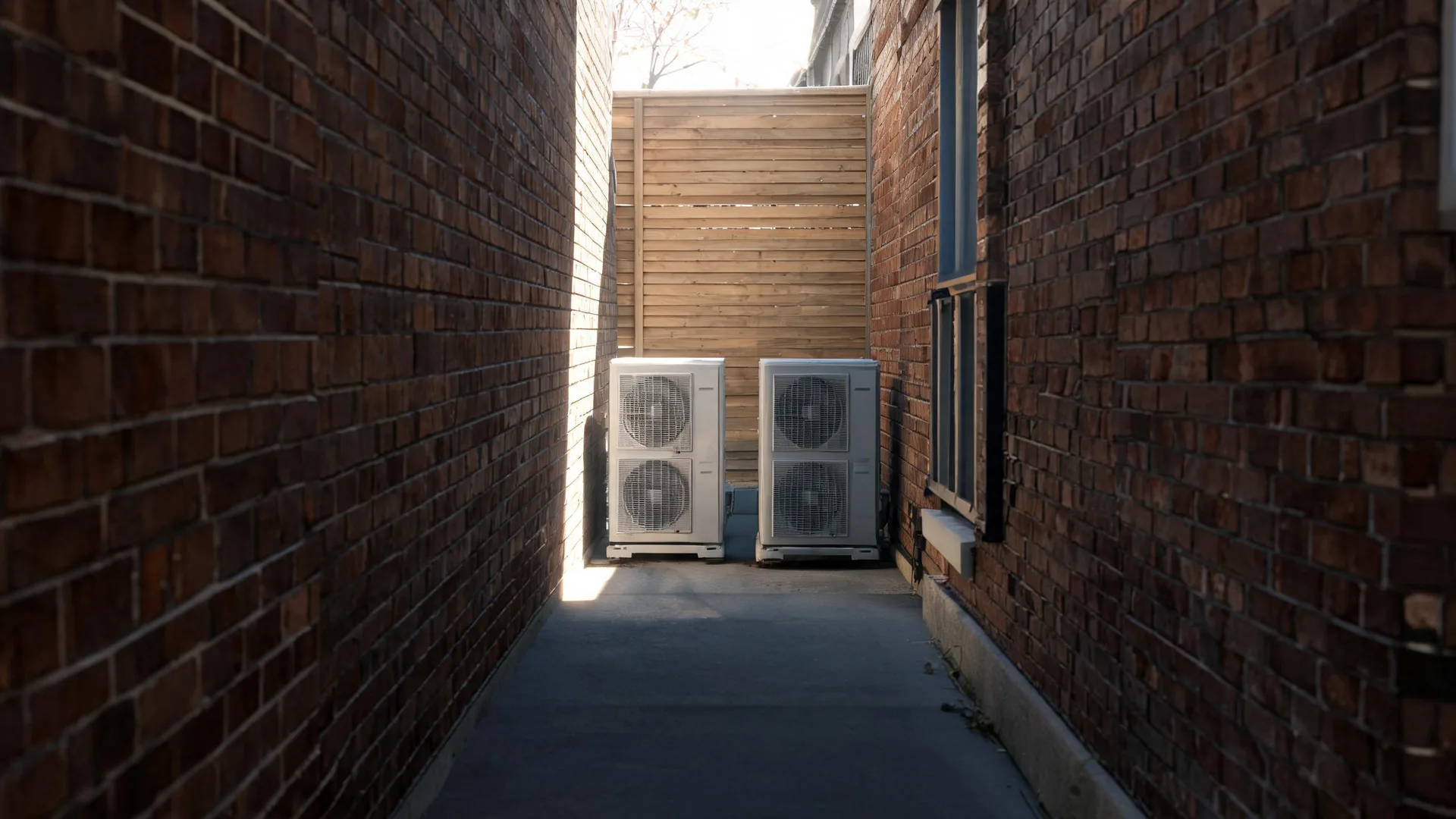
A gray heat pump outdoor unit mounted on a concrete pad next to a residential house with lap siding and stone accents.

A part that's struggling now is the one that quits later

A heat pump that's struggling doesn't fail all at once. If the reversing valve is sticking, the system may still blow warm air some of the time, so it keeps running on a part that's only doing part of its job. Each cycle it strains a little harder, and a motor or compressor that was pulling a bit too much current starts pulling more. Ice on the outdoor coil works the same way. If the defrost cycle isn't clearing it fully, more builds up next time, and the system keeps calling for heat through a coil that can't absorb it anymore. The unit doesn't stop to rest. It keeps trying to hit the setpoint, and whatever part is already weak is the one carrying that load, cycle after cycle, until it gives out.

Capacitors and contactors wear out from cycling

Every time the outdoor unit starts, the capacitor gives the compressor and fan motor the push to get going, and the contactor closes to send power to them. Years of cycling on and off wears the contacts and weakens the capacitor's charge. These are the parts most likely to fail first, and usually the cheapest to replace.

The reversing valve is what makes it a heat pump

The reversing valve switches the system between heating and cooling by redirecting refrigerant flow. If it sticks in one position, either from a worn coil inside it or a weak solenoid that's supposed to shift it, the system can get stuck blowing cold air when you need heat. This part fails less often than a capacitor, but it's a bigger repair when it does.

A heat pump that needs attention usually tells you in one of a few ways. The air from the vents turns lukewarm instead of warm, or the system runs long cycles without ever quite reaching the setpoint. Outdoors, you might notice the fan isn't spinning, or it's spinning but the unit is making a hard clicking or humming sound and not starting. Ice on the outdoor coil that doesn't clear between cycles is another one worth watching, since a healthy system defrosts itself on a schedule. Short cycling, where the unit shuts off and restarts every few minutes, points to a different kind of trouble than a system that runs constantly and never catches up. Any of these is a reason to get the system looked at rather than wait and see if it sorts itself out.

A repair decision comes down to what failed and what else might be close behind it. A capacitor or a contactor usually fails on its own, without warning the rest of the unit is in trouble. Replace it and the system runs the same as it did before. A compressor is different. It rarely fails out of nowhere. It fails because something else was already wrong, a low charge, a weak run capacitor, airflow that was restricted for a long stretch, and the compressor was the part that finally gave out under that strain. So the question isn't only what it takes to fix the part that broke. It's whether the system around it is sound enough that this is the one repair it needs for a while, or whether this failure is just the first sign of what's coming.