Night view of illuminated white Southern-style houses with wraparound porches beneath Spanish moss-draped oak trees.

Heat Pump Repair in Carrollton, GA

Tell us about the job

Takes about a minute. No obligation.

RepairHeat PumpCarroll County, GA
Step 1 of 2

What ZIP code is the job in?

This county gets hit a lot

Carroll County saw 102 severe weather events between 2015 and 2024, most of them damaging wind. Add hail and a few tornadoes to the mix. A heat pump's outdoor unit sits through all of it, exposed to wind-blown debris and hail.

A unit that still runs can still be damaged

Bent fins, a cracked fan blade or a dented cabinet from hail or flying debris does not always stop a heat pump from turning on. It can run for months with damage that cuts its output or wears down the compressor early.

7 months
October through April, your system heats
5 months
May through September, it cools
34°F
the average winter night it heats against
88°F
the average summer afternoon it cools against
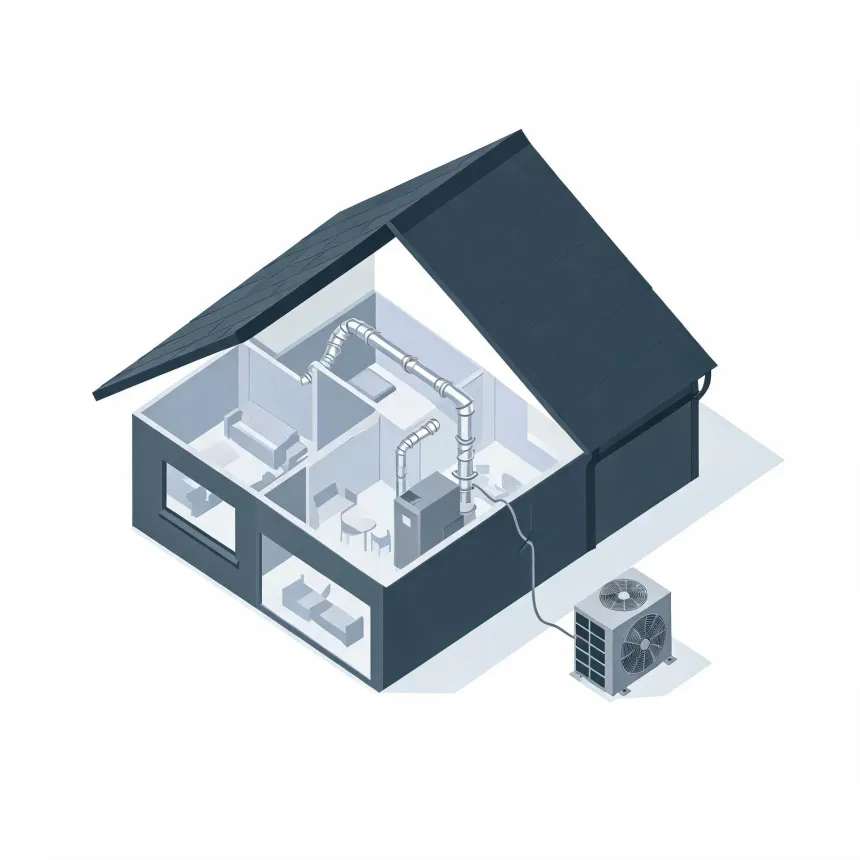
Isometric illustration of a cutaway house showing interior rooms with furniture, a furnace and ductwork, connected by a line to an outdoor condenser unit on the ground outside.
Your system heats October through April and cools May through September.

NOAA nClimDiv, 1991–2020 normals

Carrollton winters are short and mild, and summers run long but the heat pump isn't fighting extreme cold or heat most of the year.

A heat pump with less strain on it tends to be in decent shape underneath, so fixing what broke is usually worth it.

Half the homes here were built in 1991 or later

Half the homes here were built by 1991
87 damaging wind events from 2015 to 2024
Power costs 14.08 cents a kWh statewide

That matters when a heat pump starts acting up. A system installed with a newer build has usually had less time to accumulate wear beyond whatever caused the current problem. If your heat pump came with the house, check the age against that before you assume the worst. A compressor or board failure in a unit that's only a few years into its life is more likely a defect or an install issue than something worn out, and either way it points toward repair over replacement.

If the outdoor unit took a hit, get it looked at

Carrollton sees enough wind and hail that a heat pump outside can pick up damage without missing a beat. If yours has been through a storm recently, it's worth having someone check the cabinet, the fins and the fan blade even if it's still running fine.

Find a contractor
A man in a cap, dark jacket and tan pants walks up porch steps toward a navy blue front door, carrying a canvas tool bag filled with hand tools, with a potted plant in a blue planter to the right.
A white mini-split heat pump outdoor unit mounted on a concrete pad beside a gray-sided house, surrounded by gravel and green shrubs.

Years of easy work, not hard work

This heat pump runs long summers and sits idle most of a short, mild winter here. That's steady, moderate work, not the kind of strain a unit faces where winters bite hard or summers run hotter. If it's acting up now, that points toward a fix rather than a replacement. A compressor or a board that's held up this long under easy conditions usually has more life in it once whatever broke gets sorted out.

A refrigerant leak gets worse the longer it runs

A heat pump low on refrigerant still blows air, so it's easy to let it ride. But the compressor depends on refrigerant to stay cool while it runs. Keep it going low on charge and the compressor runs hotter than it should, and that heat shortens its life. A leak that would have been a simple patch and recharge can end with a compressor that needs replacing.

A struggling system hides its own warning signs

When airflow is restricted or a capacitor is weakening, the heat pump often compensates by running longer cycles to hit the setpoint. From inside the house that can look like the system working fine, just slower. Underneath, the motor and compressor are working harder than they're built to sustain, and that extra strain is what turns a part replacement into a bigger repair.

Before anyone comes out, a few things are worth checking yourself. Look at the thermostat first. Make sure it's set to heat or cool as needed and the setpoint is actually past room temperature, since a setting bumped by accident gets mistaken for a broken system all the time. Check the circuit breaker for both the indoor air handler and the outdoor unit, since a tripped breaker will stop a heat pump cold with no other sign. Pull the air filter and hold it up to light. If you can't see through it, airflow is choked and that alone can make a system blow warm or run constantly. Walk out to the outdoor unit and clear away leaves, grass clippings or anything stacked against the cabinet, since it needs open air on all sides to move heat. If the outdoor coil is caked in ice, switch the system off and let it thaw rather than forcing it to keep running.

A diagnostic starts outside at the unit, not with a clipboard. The tech checks refrigerant pressure first, then the current draw on the compressor, then the temperature split between the air going in and the air coming out. Those readings point to whichever part is struggling before anything gets opened up. A failing capacitor shows up as a motor that hums but won't start, or one that spins slower than it should. A refrigerant leak shows up as low pressure on the gauges and ice forming somewhere it shouldn't. A bad reversing valve shows up as the system blowing the wrong temperature air entirely. Once the tech finds the part that doesn't match the rest, that's the one causing the trouble, and that gets explained before any repair starts.