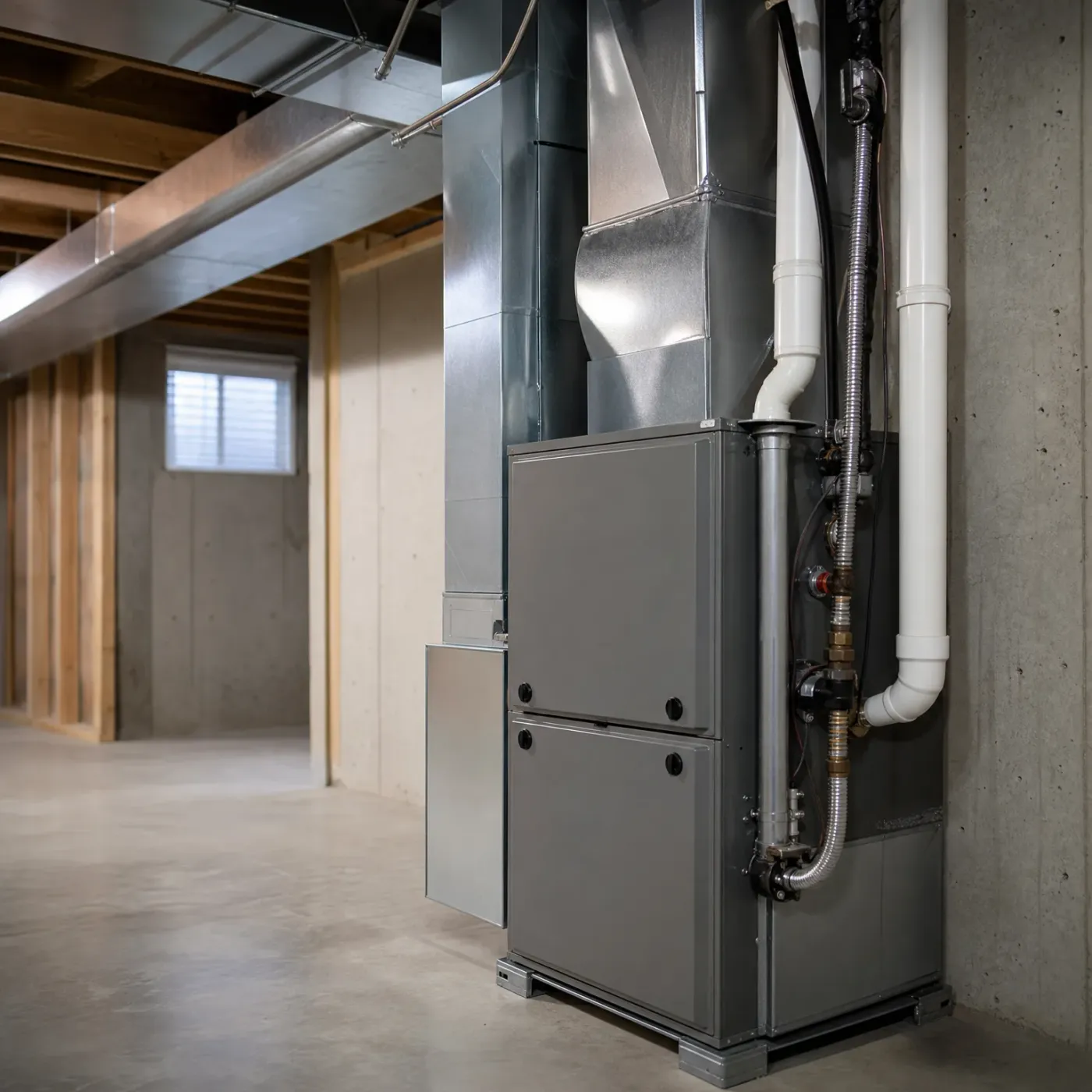




A gas furnace with two gray access panels stands on a concrete pad in a basement, with white PVC vent pipes above, sheet-metal ductwork to the right, and gas and water piping along the wall at left.

Send one request and you're done looking

Is a high-efficiency furnace worth it in Cumming, GA

Winters in Forsyth County get cold enough that a furnace runs hard for months, and a high-efficiency model costs more going in. Whether that difference pays off depends on what you're replacing and how your house uses gas. Below is what actually changes with a high-efficiency furnace here, and what doesn't. Send the form and skip the part where you call around and explain your situation to five different companies.

Hand off my installation

For most homes in Cumming, a high-efficiency furnace is worth it if the one it replaces is old enough to be a standard model, because winters here keep a furnace running for months at a time. The difference between a standard furnace and a high-efficiency one comes down to how much of the gas burned turns into heat instead of going out the flue. A standard furnace wastes more of it every time it fires, and with a cold season that runs long, that adds up over the months you're actually using it. The higher upfront cost buys a furnace that keeps more of what you're paying for as heat in the house rather than exhaust. Where it matters less is if your current furnace is already a high-efficiency model, or if gas use in your house is light to begin with. What you're replacing and how your house runs its gas are what decide the answer, not the furnace alone.

A man in a gray quarter-zip sweater sits with closed eyes and a slight smile in a dark leather armchair in a wood-paneled room, with a window, framed picture, bookshelf and a table holding a mug and papers nearby.
A man with greying hair and a beard, wearing a dark blue sweater, reclines with closed eyes and a slight smile in a brown leather armchair in a room with a bookshelf, houseplant, window, and a folded newspaper on a wooden table.
A man in a dark green sweater reclines with eyes closed in a brown leather armchair beside a wooden table holding a dark mug and a folded newspaper, with houseplants, a framed picture and a bookshelf in the background.
A man in a dark blue sweater reclines with closed eyes in a brown leather chair, beside a side table with a mug and folded newspaper, a potted plant and shelving in the background.

Where the extra efficiency goes

A standard furnace sends a lot of heat straight out the flue. A high-efficiency furnace has a second heat exchanger that pulls more warmth out of the exhaust before it leaves the house, and it vents through PVC pipe instead of a metal flue. That second exchanger is why the unit costs more to install. It's also why it uses less gas to put out the same heat, month after month, for as long as a Forsyth County winter asks it to run.


What your current setup decides

If your furnace vents through a metal flue shared with a water heater, switching to a high-efficiency model means separating that venting, since the new furnace needs its own PVC pipe to the outside. That adds work a straight swap wouldn't need. If your ducts are undersized or leaky, a more efficient furnace won't fix what the ducts are losing. A contractor who looks at the venting and the ductwork can tell you which situation you're in before you decide.

How cold does it actually get, and how long is the furnace running?

  • Winter nights average 33°F

    Overnight lows average 33°F through December, January and February, so the furnace is cycling on through the night, not just during a cold snap.

  • Heat runs October through April

    Heat runs here from October through April, about seven months. That's most of the year your furnace is the one working harder.

  • 68.7% of homes heat with gas

    68.7% of homes in Forsyth County heat with gas, same as yours likely does. That's the fuel a high-efficiency furnace actually saves you on.

NOAA nClimDiv 1991-2020 · ACS 2020-2024

When the standard furnace still makes sense

If the furnace going in now is replacing one that failed early, say ten or twelve years in, a standard furnace is the more honest choice. Something else was likely wrong, poor duct sizing, a thermostat run too hard, a unit sized wrong for the house, and a high-efficiency furnace won't fix any of that. It'll just be a more expensive version of the same problem. A standard furnace also makes sense in a house that's been retrofitted for gas but still has an older flue that would need real work to vent a high-efficiency unit's PVC pipe. In that case the install cost to accommodate the new venting can erase a good part of what you'd save on gas over the years you own the furnace.

When the high-efficiency furnace earns its keep

If the furnace being replaced ran eighteen, twenty years or more, it was almost certainly standard efficiency, and the house has been losing a real share of its heat out the flue for most of that time. Swapping in a high-efficiency furnace at that point captures heat the old one never did, every winter, for as long as the new furnace runs. A house with the ductwork already in reasonable shape sees that gain show up as lower gas use through the cold months, not as a single upgrade that pays for itself once and stops mattering. The longer winters here run, October through April, the more those months of better heat recovery add up before the furnace is replaced again.

A beige residential furnace stands on a concrete basement floor beside galvanized sheet-metal ductwork, a round flue pipe, copper gas piping, and a PVC condensate line, with a wood-paneled wall at right.
Before you get your furnace installation
A gray high-efficiency furnace in a basement with white PVC vent pipes, sheet-metal ductwork, copper and black piping, a condensate pump, and insulated walls above a concrete floor.
After you get your furnace installation
A gray high-efficiency furnace in an unfinished basement, connected to sheet-metal ductwork and white PVC vent pipes along a concrete wall, with wood-framed walls and a small window in the background.

Finding a pro stops being your job

Describe your furnace job once, to one pro.

Send the form and the search for an installer is over.

Start one form

No charge to send it. You decide if you hire them.

Standard or High-Efficiency Furnace

Standard furnace

  • Costs less to install, which matters if you're also budgeting for other work on the house.
  • Venting runs through metal flue pipe, the same path the old furnace likely used, so there's less to change.
  • Simpler to service since there's one heat exchanger instead of two.
  • Makes sense if the furnace it replaces failed early, since the house may have other issues driving up gas use.
  • Parts and repairs are familiar to most furnace techs in the area, since it's been the standard for decades.

High-efficiency furnace

  • Pulls more heat out of the exhaust before it leaves the house, so less gas goes straight out the flue.
  • Vents through PVC pipe, which usually means a new vent path rather than reusing the old metal flue.
  • Costs more upfront, and that gap is what has to pay for itself over time.
  • Makes the most sense when the furnace it's replacing is old enough to be a standard model and ran for its full lifespan.
  • Pays off faster in a house where the furnace runs for months at a stretch, not just on the coldest nights.
  • Needs a condensate line for the water the second heat exchanger produces, which is new plumbing most standard installs don't have.
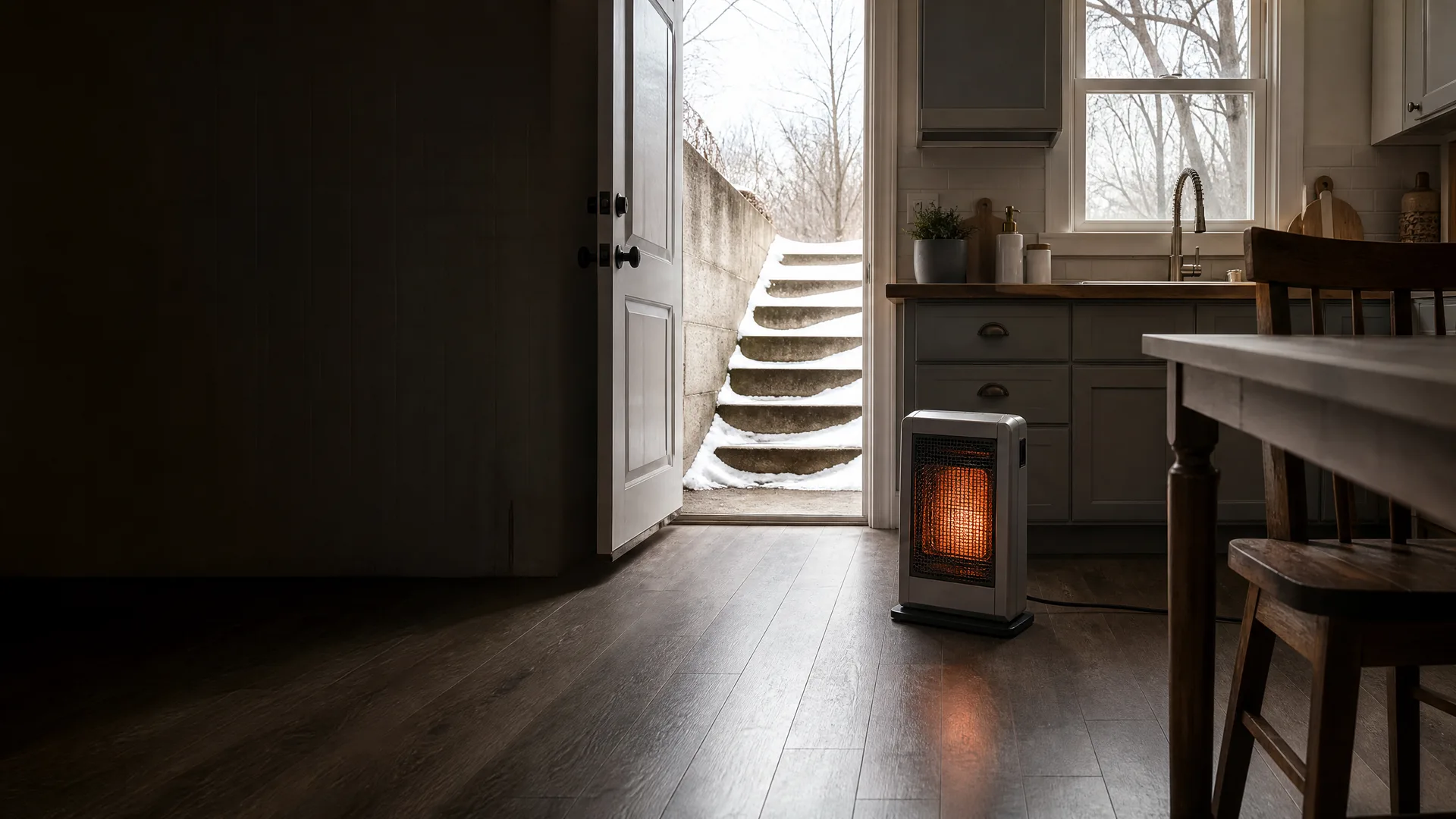
A portable electric space heater with glowing orange elements sits on a dark wood floor near an open exterior door that reveals snow-dusted concrete steps, with a kitchen counter, sink, window and wooden table to the right.

The thermostat still reads 58 when you come down. Outside it's been in the low 30s all night, the kind of cold that settled in back in December and never really left. You've got the space heater pulled up close to the kitchen table, its coil glowing orange, because the furnace stopped answering an hour ago. The basement door is open behind it. You went down once already, saw the flame sensor and the inducer motor and had no idea what you were looking at, and came back up. Your coffee's gone cold faster than usual. Outside, Forsyth County is waking up to another gray morning, and somewhere under the house, the furnace that got you through January just isn't trying anymore.

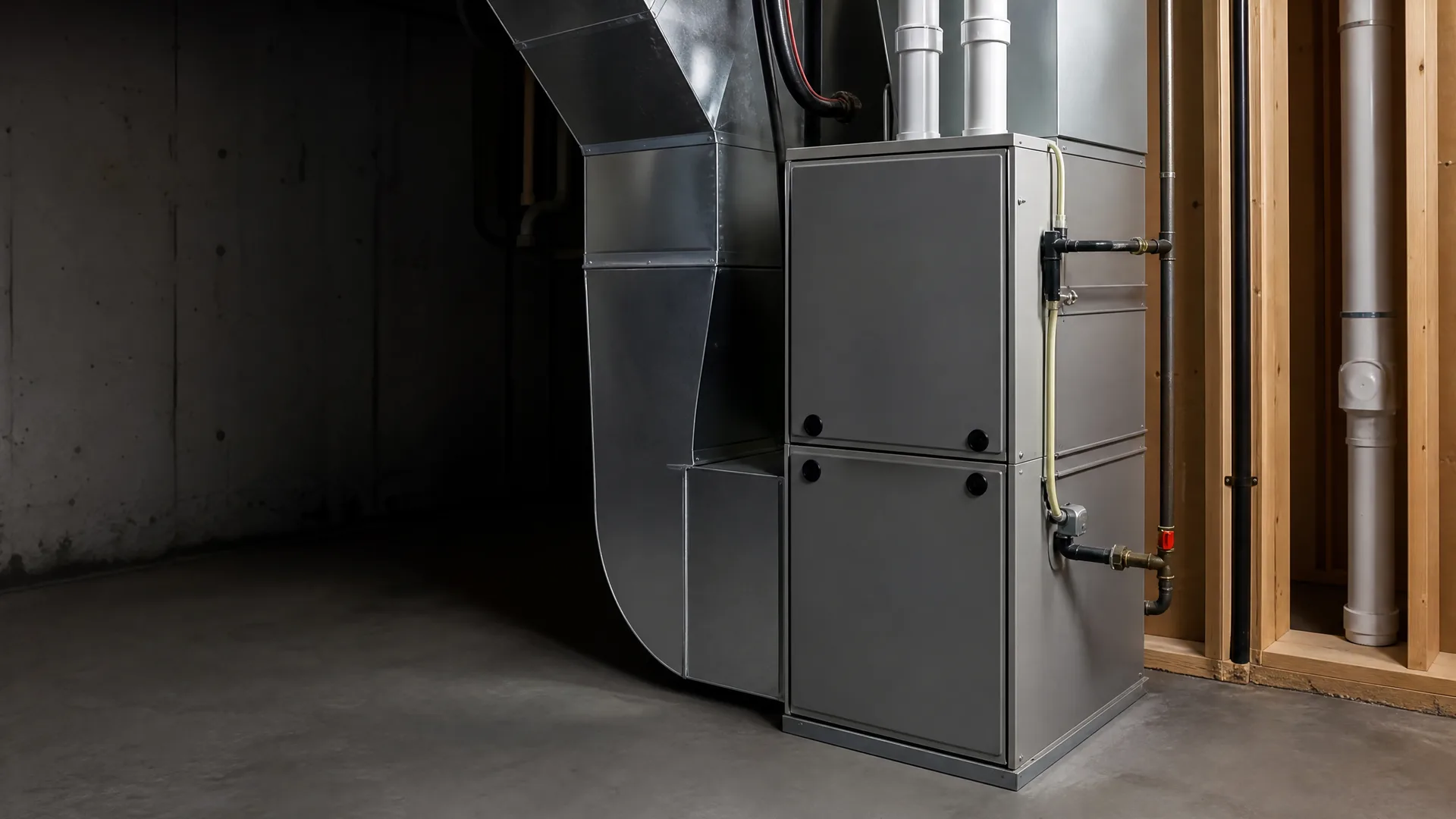
A gray high-efficiency furnace stands on a concrete basement floor beside galvanized sheet-metal ductwork, white PVC vent pipes, copper and black piping, and unfinished wood stud framing.
A furnace running the way it should: steady heat moving through the ducts, the condensate draining out through the PVC without a fuss.
A gray furnace with two access panels stands on a concrete basement floor beside sheet-metal ductwork, with pipes, flexible conduit and an electrical box on the concrete wall to the left.
Flue gas is cool enough to vent through plastic pipe, which only happens once that second heat exchanger has done its job.

How the two actually run

  • A single-stage standard furnace fires at one rate: full blast, then off, which is why rooms far from the furnace run colder than the one next to it.
  • A two-stage or modulating high-efficiency furnace can fire at a lower rate and hold it longer, so heat spreads more evenly through the ducts.
  • The inducer motor on a high-efficiency furnace pulls exhaust through the second heat exchanger before it ever reaches the vent pipe.
  • That induced draft is also why high-efficiency furnaces can vent sideways through a wall instead of needing a vertical flue.
  • Condensate from the second heat exchanger has to drain somewhere, so a high-efficiency furnace needs a condensate line and a place for it to go.
  • A variable-speed blower motor, common on higher-end high-efficiency models, adjusts airflow instead of running at one fixed speed.

A standard furnace has one gear. The burner fires at full rate until the thermostat is satisfied, then shuts off completely, and the room farthest from the unit waits the longest for warm air to reach it. A two-stage or modulating furnace can fire low and stay there, which is most of what changes day to day: longer, gentler run times instead of short blasts, and less of a gap between the room next to the furnace and the one down the hall.

The rest of the difference is in how the exhaust leaves the house. An inducer motor pulls the exhaust through a second heat exchanger before it reaches the vent, pulling more heat out of that air than a standard furnace does. That same induced draft means the flue gas is cool enough to run through PVC pipe, and cool enough that it doesn't need to rise straight up through the roof. Venting can run sideways through an exterior wall instead, which matters if the old furnace's flue path isn't where you'd want to put the new one.

Pulling that extra heat out of the exhaust also pulls moisture out of it, and that moisture has to go somewhere. A high-efficiency furnace needs a condensate line, running to a drain or a pump, something a standard furnace never had to deal with.

Higher-end high-efficiency models often pair the two-stage burner with a variable-speed blower, which ramps airflow up and down instead of switching between on and off.

Winter nights average 33°F

At 33°F, your furnace isn't shrugging off the occasional cold night. That's the average low for three straight months, so it's holding a steady burn from evening through morning most of the winter, not just kicking on here and there.

NOAA nClimDiv 1991-2020

A gray high-efficiency furnace with white PVC vent pipes stands beside sheet-metal ductwork and a water heater in an unfinished basement with concrete walls and wood framing.

Running the way it's supposed to

PVC flue pipe means the exhaust is cool enough to vent through plastic, which only happens once the second heat exchanger has pulled the heat out of it. The ductwork ties in clean, and the furnace sits ready for another winter of steady overnight runs.

A beige gas furnace with a metal flue pipe stands in a basement against concrete block walls, beside sheet-metal ductwork, copper and white plastic pipes, and a water heater at right.

A furnace on its way out

Galvanized metal venting on an older furnace like this one means the exhaust is still hot enough that it has to be. No second heat exchanger, no PVC. It'll heat the house, but it's sending more of what you pay for straight up the flue.

A closed silver laptop and a light ceramic mug of dark coffee sit on a wooden table, with a window showing a sunset at left and a kitchen counter with a cutting board and potted plant in the background.

So is it worth it

If the furnace being replaced is old enough to be a standard model, a high-efficiency furnace is worth the extra cost here. Forsyth County winters keep a furnace running most nights from October through April, and that's enough time for the difference to matter. If the furnace failed early for some other reason, a standard model is the more honest replacement, and there's no shame in choosing it.

Either way, you still have to find someone who installs furnaces correctly, sized right for your house and vented the way the furnace actually calls for. That usually means calling a few contractors, explaining the same thing to each one, and sitting with quotes that don't line up. Send the form and that part is done. Someone qualified gets in touch, and you go from there.

A gray upholstered sofa with a textured cushion sits beside a dark round side table holding a vase of green foliage, with a table lamp and sheer-curtained window behind.
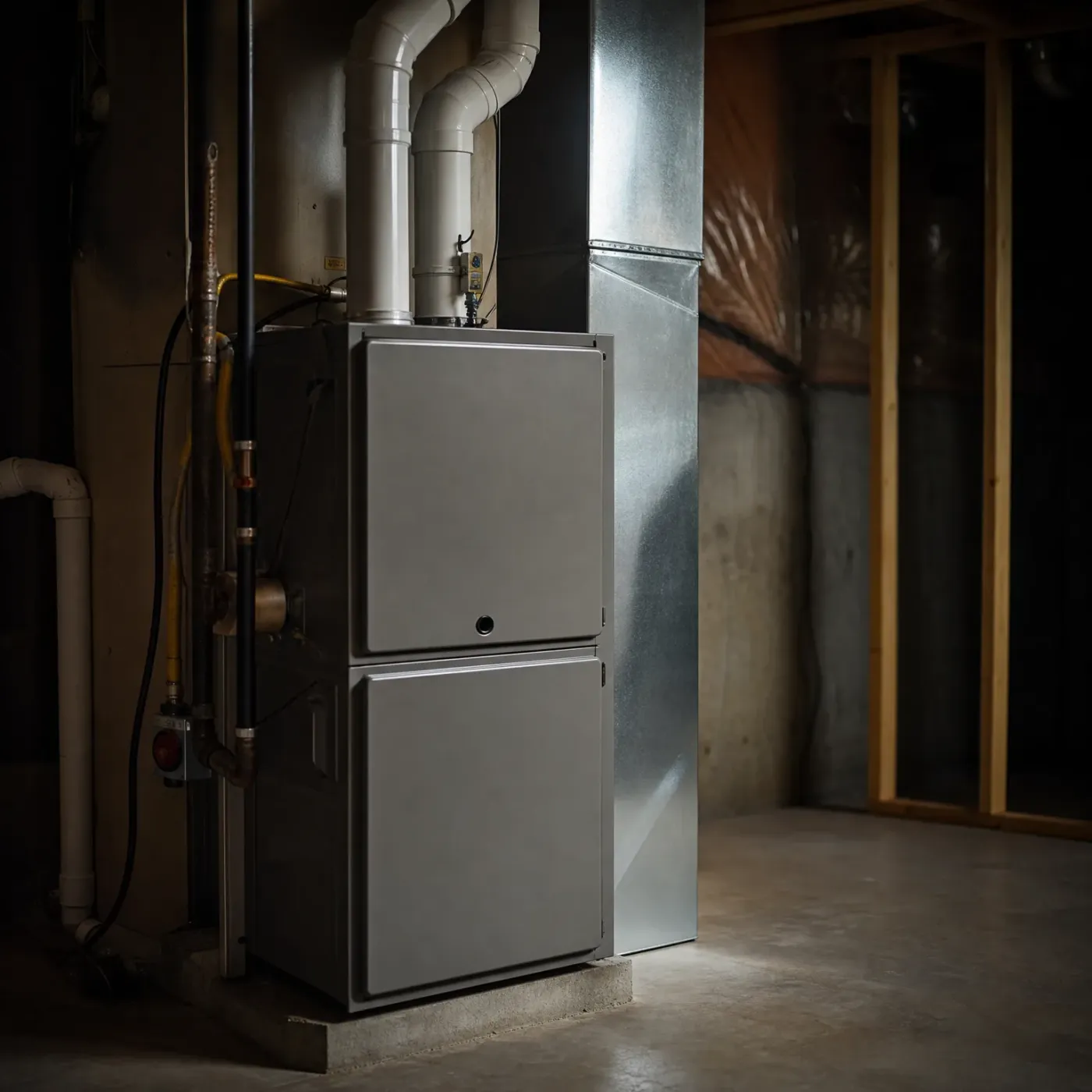
A gray furnace with attached sheet-metal ductwork and PVC vent pipes stands in a basement with concrete walls and floor beside exposed wood framing and vertical pipes.

Let someone else find the pro

New system or replacementFurnace or heatingForsyth County, GA
Step 1 of 2

What ZIP code is the job in?