Profile view of a bearded man wearing a dark baseball cap and a dark gray T-shirt against a plain off-white background.

What size furnace a Georgia home needs

New system or replacementFurnace or heatingGeorgia
Step 1 of 2

What ZIP code is the job in?

What size furnace do I need for my house in Georgia?

You want a straight number before a contractor shows up, not a guessing game once they're standing in your living room. Furnace size depends on your square footage and how your house holds heat, and getting it wrong in either direction costs you: too small and it runs constantly without keeping up, too large and it short cycles and wears out early. A load calculation settles it, but a rough range tells you what to expect.

Most Georgia homes need between 40,000 and 60,000 BTUs, but a load calculation gives the real number

A 2,000 square foot house in Georgia typically lands somewhere between 40,000 and 60,000 BTUs, well below what the same house would need in a colder state. Winters here don't push a furnace hard, so the sizing math leans smaller than homeowners moving in from up north expect. The exact number still depends on your ceiling height, how many windows you have, and how well the house holds heat, which is why a contractor runs a load calculation room by room instead of going off square footage alone. Since most homes here heat with electricity, that calculation also decides what size electric furnace or heat pump matches your ductwork, and sizing it right keeps the unit from short cycling or running nonstop.

An older gas furnace with two louvered front panels stands on a concrete basement floor beside galvanized sheet-metal ductwork, pipes, and a weathered concrete wall.
Before you get your furnace installation
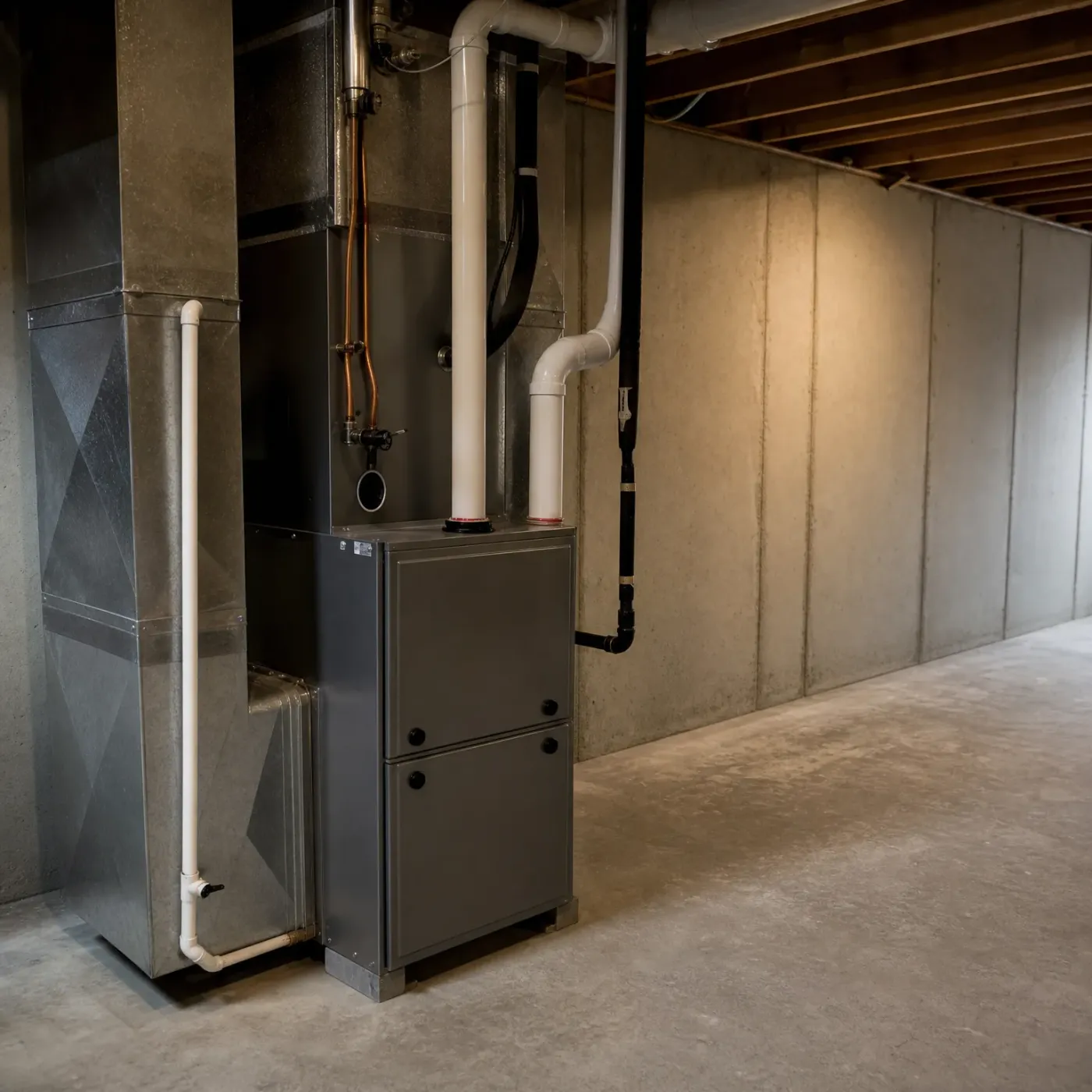
A gray high-efficiency furnace in a basement, connected to sheet-metal ductwork on the left and white PVC vent pipes above, with black gas and drain piping and an exposed wood-stud wall with OSB sheathing on the right.
After you get your furnace installation

Sizing a furnace starts with your house, not the unit sitting in the basement now. A contractor works out how much heat your home actually loses, based on square footage, insulation, how many windows you have and your ceiling height, then matches a furnace to that number. Guessing too big causes trouble. A furnace that's too large for the space heats it fast, shuts off, then kicks back on again and again through the night. That short cycling puts more wear on the heat exchanger than steady operation does. Go too small and the furnace runs almost nonstop on the coldest nights and still can't quite reach the number on the thermostat. Since most homes in Georgia heat with electricity, the sizing conversation usually comes down to kW rating against heat loss, not the gas input numbers you might see quoted elsewhere. None of it matters much, though, if the ductwork can't keep up. Part of a proper installation is checking that the ducts can actually carry the air a correctly sized furnace is built to move.

Getting the Size Right

  • Georgia's climate zones call for furnace sizing between 30 and 45 BTUs per square foot in most of the state, less in coastal areas and more near the north Georgia mountains.
  • A load calculation checks your home's square footage, insulation, window count and ceiling height instead of just matching the size of the unit you already have.
  • An oversized furnace short cycles, turning on and off before it heats evenly, which wears out the heat exchanger faster.
  • An undersized furnace runs long stretches without reaching the thermostat setting, especially on the coldest nights of the year.
  • Since most Georgia homes heat with electricity, sizing usually centers on matching the furnace's kW rating to the heat loss of the house rather than a gas input rate.
  • A contractor doing a proper installation measures duct size too, since even a correctly sized furnace can't move enough air through ductwork that's too small.
A man in a gray sweater reclines in a brown leather armchair with his eyes closed, beside a wooden side table holding a mug, a folded newspaper and a potted plant, with a bookshelf and sunlit window behind him.
A man with greying hair and a dark sweater leans back on an armchair with his eyes closed and a slight smile, in a living room with a bookshelf, plant, folded newspaper and mug on a wooden table.
A man in a gray fleece jacket sits reclined in a leather chair with his eyes closed, in a room with bookshelves, a table lamp, a window, and a desk holding a folded newspaper and a dark mug.
A bearded man in a gray fleece pullover sits with eyes closed in a brown leather armchair in a living room, with a floor lamp, bookshelf, potted plants, a side table holding newspapers and a dark mug, and a bright window behind him.

Send one request and you're done looking

Skip the round of in-home estimates for a new furnace.

Sending the form costs nothing.

A gray high-efficiency furnace with white PVC vent pipes stands against a concrete basement wall beside sheet-metal ductwork, a small condensate pump on the floor, and exposed wood framing at left.

Sized right, running quiet

A furnace matched to your home's load heats evenly and shuts off when the thermostat's satisfied. The ductwork moves the air it was built to move, and the flue vents it off without strain. Nothing is working harder than it has to.

A gray sheet-metal furnace with flue pipe and adjacent ductwork stands against a stone basement wall on a concrete floor, with white PVC and metal pipes running nearby.

Sized wrong, working against itself

An oversized furnace blasts heat then shuts off fast, leaving cold spots once it cycles down. An undersized one runs long and still can't catch up on a cold night. Either way, the gas lines and ductwork feeding it stay taxed longer than they should.

A closed silver laptop and a glazed ceramic mug on a wooden table, with a blurred kitchen counter, potted plant, cutting board and window in the background.

A furnace that's wrong for your house shows up on your bill

An oversized furnace heats your house fast, shuts off, then kicks back on again twenty minutes later. You'll notice rooms that never feel settled, and a thermostat that seems to be working all the time without getting anywhere. An undersized one just runs and runs on a cold January morning, straining to keep up, and your electric bill carries that cost all winter since most homes here heat with electric furnaces or heat pumps.

Getting the size right means a load calculation on your specific house, not a guess based on square footage alone. That's a job for a contractor who'll measure your home rather than estimate it. Once you send the form, you're done hunting through listings, calling around for quotes, and explaining your situation over and over to different companies. Someone qualified gets matched to your house, and the sizing gets handled by a person standing in your home instead of a number you worked out yourself.

Interior corner of a dining room with a round wooden table, a ceramic vase holding olive branches, a dark spindle-back chair near a curtained window, and a sideboard with a lamp against beige walls.

Winter nights average 36°F statewide

36°F doesn't sound hard, but that's the average night, pulled down by the cold snaps mixed in with milder ones. Your furnace has to cover both, which is exactly what a load calculation is for.

NOAA nClimDiv 1991-2020 county normals weighted by homes

The Right Size, Settled

  • The right size for your furnace comes from a load calculation, not a square footage chart alone.
  • A furnace sized to your home's actual load runs evenly and doesn't short cycle through the winter.
  • Getting the size wrong shows up later as higher bills and rooms that never feel right.
  • A licensed installer runs the load calculation and sizes the equipment to match what it found.
  • Once you're matched with one, you're done calling around and repeating the same details to different companies.
  • Sending the form replaces the search for contractors and the back and forth of comparing quotes yourself.

A load calculation is the only way to know what size furnace your Georgia home needs. Square footage alone leaves out your insulation, your windows, how your house holds heat on a cold night, and a furnace sized without that information runs wrong for as long as it's in your house. Too big and it short cycles, heating fast then shutting off before the house actually warms through. Too small and it runs constantly, straining to keep up on the coldest nights of the year. Either way you feel it in rooms that never settle and in a bill that doesn't match what you're getting. A licensed installer runs the load calculation, accounts for what's actually in your home, and sizes the equipment to that number instead of a guess.

Finding that installer is the part that usually falls on you. Searching for contractors who serve your area, calling several, explaining your house and your situation to each one, then sitting with quotes that are hard to compare because no two companies measured the same way. Send the form once and that work is off your plate. You're matched with a licensed installer, and from there it's one conversation instead of several, with someone who already knows what you're looking for. The sizing question gets answered properly, by someone standing in your house with the numbers in front of them, and you're not the one holding the phone to make that happen.


A gray high-efficiency furnace in an unfinished basement with concrete walls and floor, connected to sheet-metal ductwork, white PVC vent pipes, and a black drain line beneath exposed wood joists.

Finding a pro stops being your job

Hand it over

Describe the project once instead of to every installer.

You're not committing to anything by asking.