A heat pump in Floyd County works hard both ways, cooling through the long muggy stretch and then switching over to carry the heat all winter. With most homes here running on electric heat, that unit rarely gets a break. How long yours lasts, and how well it holds up, comes down to whether it was sized and installed right in the first place. That's not something you can check by reading reviews or guessing from a few phone quotes. You'd normally spend an afternoon calling around Rome, explaining your situation over and over, then trying to compare bids that don't even cover the same work. This connects you instead with one licensed local contractor, someone who installs and services this equipment around Rome and Floyd County every season and knows what makes a heat pump hold up here and what cuts its life short. No bidding war, no repeating yourself to five different companies. Just a straight path to someone who already knows this climate and this equipment.
A heat pump in Rome lasts about 12 to 15 years. It runs both directions here, cooling the house through the long sticky summer and then carrying the heat all winter, so it logs more hours a year than an air conditioner that gets to rest half the time. Winters around Floyd County bring real cold, and on the hardest mornings the unit has to work through frost on the outdoor coil to keep up, which adds wear a furnace never sees. How close your system gets to that 15-year mark depends on whether it was sized right for your house, whether it's been serviced on a regular schedule, and whether small problems got fixed early instead of left to spread. A unit that's run hard without that care can fall short of 12 years. One that's been kept up can push past 15.
What does Floyd County's climate actually ask of your heat pump?
Winter nights average 34°F
Nights this cold mean the unit leans on its backup heat strip often, and that's the part that drives up wear and your power bill both.
Heat runs October through April
Seven months of heat means more hours worked each year than a furnace that sits idle all summer, and more hours means parts wear sooner.
Cooling runs May through September
Add five months of cooling to that same seven months of heat and the unit is working most weeks of the year, with barely a season off.
NOAA nClimDiv 1991-2020
A unit put in right
A heat pump that's sized for your house and installed correctly will run fewer hours to hold the same temperature, and that difference shows up over its whole life. One set too large for the house short cycles, turning off and on before it finishes a full run, and that wears the compressor faster than steady operation would. One set too small runs flat out on the coldest nights and leans harder on the backup heat strip than it should. The refrigerant charge has to be right too, because a system low on charge works harder for the same result. None of this is something you can check from outside the cabinet. It's set at installation and it stays that way for the life of the unit.
Finding someone qualified
Floyd County has no shortage of people who will sell you a heat pump. Finding the one who sizes it to your house, sets the charge correctly, and stands behind the work after the truck leaves is a different search, and most homeowners don't have a way to tell the difference from a sales pitch. That usually means calling around, explaining the same details to each one, and comparing quotes that may not even cover the same work. This page connects you with one licensed local contractor who installs heat pumps in this area and knows what Rome winters and summers put them through, so you're not sorting through several calls to get an answer.
No quotes to chase
A licensed installer who works in Floyd County gets your project.
Skip collecting and comparing quotes for the new heat pump.
Asking costs nothing, and the choice to hire stays yours.
What Determines Which One You Get
Runs the full 12 to 15 years
The unit was sized for your house, not just swapped in to match what was there before.
The refrigerant charge was checked against the manufacturer's spec, not just topped off by feel.
The ductwork moves enough air for the system, so it never has to lean on the backup heat strip to catch up.
Filters get changed on a schedule and the coil stays clean, so the unit isn't working harder than it has to.
Whoever installed it is still around to service it, so small issues get caught before they turn into a failed compressor.
Falls short of it
A unit sized for the last house, or guessed at, short cycles and never settles into an efficient run.
A low refrigerant charge makes the compressor work harder every single hour it runs, all year.
Undersized ductwork forces the backup heat strip on more than it should be, and that strip is expensive to run.
A clogged filter or dirty coil makes the system strain for the same temperature, which adds up over a Rome summer.
No one who knows the install is around to catch a failing part early, so small problems turn into early replacement.
Running the way it should
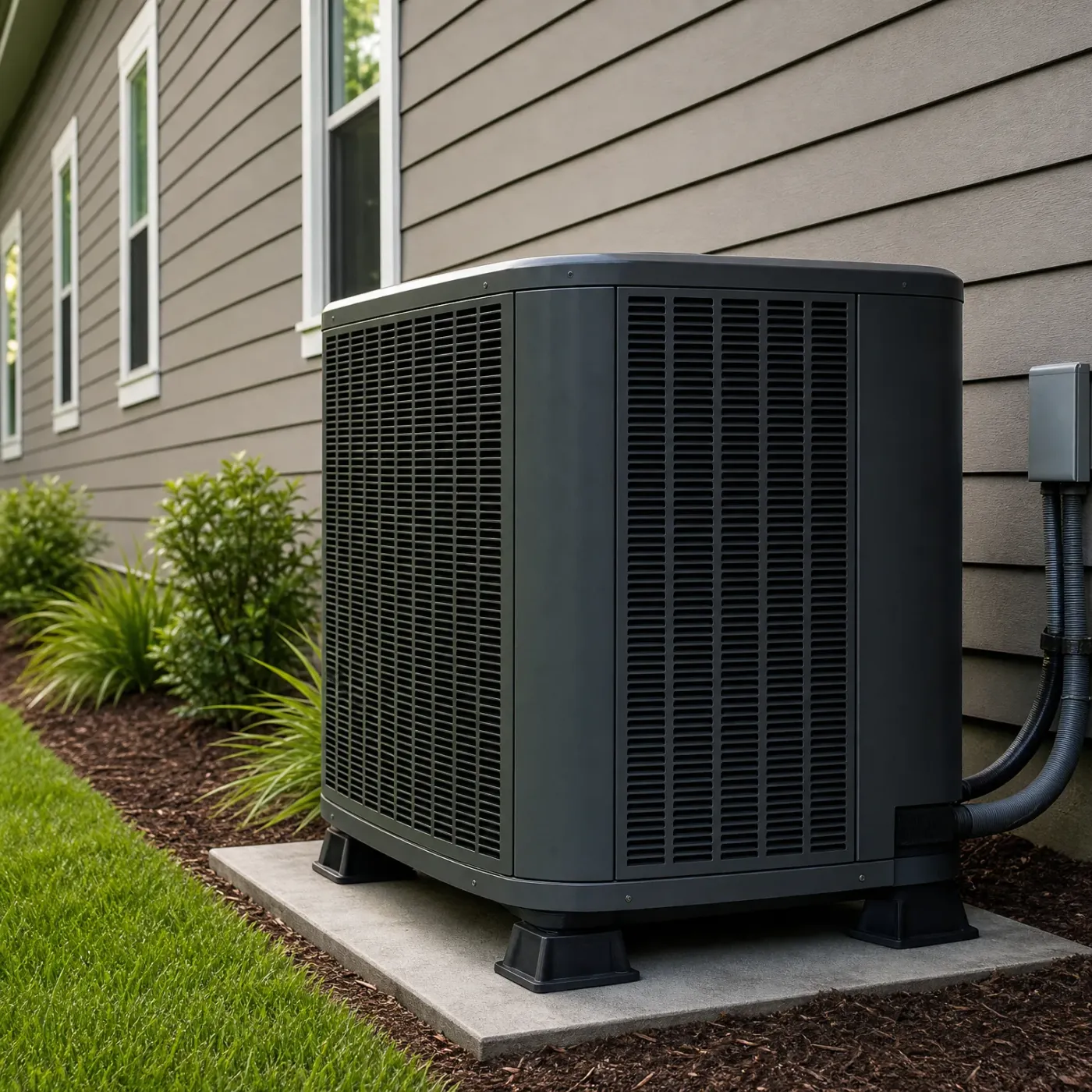
This is a heat pump doing its job without complaint. The pad is level, the lines and conduit run clean up the wall to the disconnect, and there's clearance all around for air to move through the coil. A unit set up like this can reach that 12 to 15 year mark.
Set up to struggle
Here the unit sits flush against the siding with bare concrete pressing in close on every side. With no gravel bed or soil to drain into and little room to breathe, the coil works harder to pull in air, and that strain adds up year after year.
Does the backup heat strip wear out the heat pump faster?
You've noticed the unit kicking on that backup strip more than you'd expect, especially on the colder nights, and you're wondering if that's just extra electric cost or if it's actually putting more strain on the heat pump itself. It seems like a fair thing to worry about, since the strip only comes on when the system is already struggling to keep up.
The strip itself doesn't wear on the heat pump. It's a separate heating element.
The backup strip is electric resistance heat, built into the air handler, not part of the compressor or the outdoor unit. When it runs, it's not asking anything extra of the heat pump's moving parts. What it does tell you is how the heat pump is holding up on its own. If the strip is coming on often on nights that aren't especially cold, that usually points to something else going on, low refrigerant charge, a dirty coil, or a unit that was undersized for the house to begin with. Any of those make the heat pump lean on backup heat sooner than it should, and that's the part worth having checked, not the strip.
A heat pump's compressor is rated to run a set number of hours before it's expected to wear out, and in Floyd County those hours stack up faster than they would somewhere with a shorter summer and a milder winter.
That's why a unit here tends to land nearer 12 years than 15, even when it's sized right and serviced on schedule, and why skipping either one tends to show up early rather than late.
Power here costs 15.50 cents per kilowatt-hour
At 15.50 cents per kilowatt-hour, every hour that backup strip runs on a cold night shows up on your bill right away. A heat pump holding its charge and airflow leans on that strip less, which is one more reason a unit kept in good shape costs you less to run, not just longer to own.
EIA-861 2025
Before you get your heat pump installationAfter you get your heat pump installation
1
The thermostat calls, and the reversing valve sets the flow direction.
2
The compressor pressurizes refrigerant and sends it to the outdoor coil.
3
The outdoor coil pulls heat from the outside air into the refrigerant.
4
The indoor coil releases that heat into the air moving through your ducts.
12 to 15 years, if it's set up and kept up right
That's what a heat pump in Floyd County gets you. Running both directions, all year, with the backup strip picking up the coldest nights, it's a unit that earns its keep. Sized right, installed right, and checked on now and then, it'll hold that range. Neglected or crammed in to fit a budget, it won't.
Finding someone qualified to install or service one isn't always simple. You could spend an afternoon calling around Rome, explaining the same thing to three different companies, then sitting with quotes trying to tell which one actually knows this equipment. A local contractor who works on heat pumps all year in this climate already knows what tends to go wrong here and what a proper install looks like. You talk to one person, once, and they take it from there.