





Single-story brick and siding houses with lawns behind a long trimmed hedge, framed by large oak branches draped with Spanish moss under an overcast sky.

Heat Pump Repair in Grovetown, GA

Tell us about the job

Takes about a minute. No obligation.

RepairHeat PumpColumbia County, GA
Step 1 of 2

What ZIP code is the job in?

A heat pump works year round, so a compressor or reversing valve near the end of its life has already carried more hours than a furnace or an AC unit would alone. Age matters, but so does the pattern. One repair for a failed capacitor or a stuck contactor is just that, a repair, and the system goes back to normal. Repeated calls for the same symptom, like a unit that keeps losing refrigerant charge or short cycling no matter what gets fixed, usually point to a bigger problem underneath the one you can see. A contractor can tell you whether the compressor itself is still sound, since that part is the most expensive to replace and the hardest to justify replacing on its own. If the rest of the system is aging alongside it, repairing just the one failure can mean facing another breakdown soon after.

5 months
November through March, your system heats
5 months
May through September, it cools
37°F
the average winter night it heats against
90°F
the average summer afternoon it cools against
Isometric cutaway illustration of a single-story house showing interior ductwork, an air handler and rooms, with an outdoor condenser unit connected by refrigerant lines on a plain white background.
Your system heats November through March and cools May through September.

NOAA nClimDiv, 1991–2020 normals

A heat pump that won't switch between heating and cooling might just need the reversing valve looked at, not a whole new system.

Check the outdoor unit for ice buildup and the thermostat for a mode that won't change before anyone comes out.

Half the homes here were built in 1999 or later, so the heat pump probably is too

Half the homes here were built by 1999
92 damaging wind events from 2015 to 2024
Power costs 14.08 cents a kWh statewide

Heat pumps here switch over to heating in November, right after a stretch of easier months. That first cold snap puts a real load on the reversing valve and the compressor, and if either one was already marginal, this is when it gives out. Same thing in reverse come May, when cooling starts and the system has to push harder than it has in months. A unit that seemed fine in October or April can fail in the first week it's actually asked to work. If yours is acting up right as the season turns, that timing is worth mentioning to whoever comes out.

Repair it

If your system came with a newer house, it likely has plenty of life left. Repair is usually the right call.

Find a contractor
A man in a cap, dark long-sleeved shirt and brown work pants carries a canvas tool bag up porch steps toward a blue front door, with a shrub in a blue planter beside it.
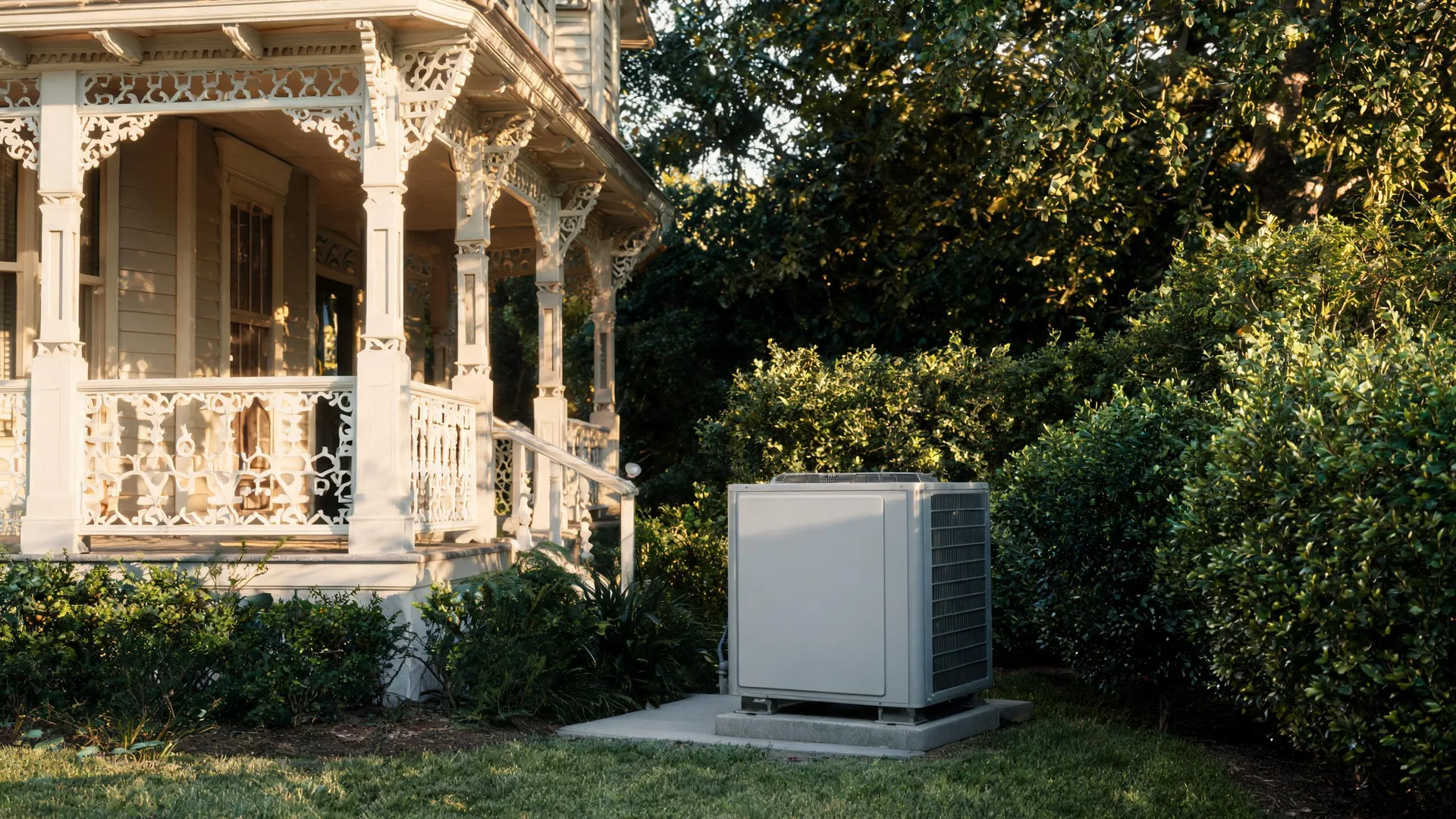
A gray heat pump outdoor unit mounted on a concrete pad next to a residential house with lap siding and stone accents.

How long this one's been running matters

A heat pump that's never had major work done to it, running in a house built in 1999 or later, hasn't logged enough hours on its own to wear out a compressor. If the unit is original to the house, a failed capacitor or a bad reversing valve is a repair, not a sign the system is done. Worth asking whoever comes out whether the unit matches the age of the house. That tells you how much life is likely left in it.

What wears out first

The contactor and the capacitor take the brunt of daily cycling, and they're usually the first things to fail. A weakening capacitor makes the outdoor fan or compressor struggle to start, sometimes with a hum and no spin. A stuck or pitted contactor can keep the outdoor unit from kicking on at all, or keep it running when it should shut off.
What a bad sensor looks like from inside the house

A failing defrost sensor or control board won't always announce itself as an electrical problem. It shows up as a system stuck in one mode, ice that builds up on the outdoor coil and never clears, or a unit that short cycles no matter what the thermostat is set to. Those symptoms can look like a refrigerant problem even when the charge is fine, which is why the sensor and board get checked before anyone starts chasing a leak.

Most of the time the first sign is comfort, not noise. A room that won't hold temperature, air coming out lukewarm instead of hot or cold, a system that runs long stretches without catching up. Short cycling is worth paying attention to, where the unit kicks on and off in quick bursts instead of running a full cycle. So is ice on the outdoor coil that doesn't clear on its own, since a working defrost cycle should handle that without help. A hum from the outdoor unit with no fan movement usually means something electrical, not mechanical. None of these mean the whole system is done. They mean something specific failed, and a contractor can usually tell you what within a few minutes of looking.

A diagnostic call starts outside, at the unit itself. A contractor checks refrigerant pressure, looks at how the compressor is drawing current, and watches whether the outdoor fan spins freely or hesitates. Inside, the air handler gets checked for airflow, since weak airflow across the indoor coil can mimic a refrigerant problem that isn't really there. The thermostat gets tested too, especially the call for heat or cool, since a signal that isn't reaching the unit can look exactly like a failed part once it's outside. Most of this gets sorted out with gauges and a multimeter, not by replacing things one at a time to see what helps. By the time a contractor is ready to talk, they usually know which part failed and why, not just that something did.