White two-story houses with wraparound porches and Spanish moss-draped oak trees photographed along a residential street at night.

Heat Pump Repair in Fort Oglethorpe, GA

Tell us about the job

Takes about a minute. No obligation.

RepairHeat PumpCatoosa County, GA
Step 1 of 2

What ZIP code is the job in?

A long summer, but not a hard one on the equipment

Catoosa County runs a long cooling season, but the climate here is rated mild overall, not extreme. The air sits heavy, with a dew point around 66°F in June, July and August, so a heat pump works to wring moisture out as much as to cool the house. That is steady work, not punishing work.

What this means for a repair call

A heat pump in this county usually isn't failing because it has been run into the ground. Something that breaks here is more often a part reaching the end of its life or a system that missed maintenance, not a machine worn out from fighting the climate. That's a better position to repair from.

7 months
October through April, your system heats
5 months
May through September, it cools
33°F
the average winter night it heats against
88°F
the average summer afternoon it cools against
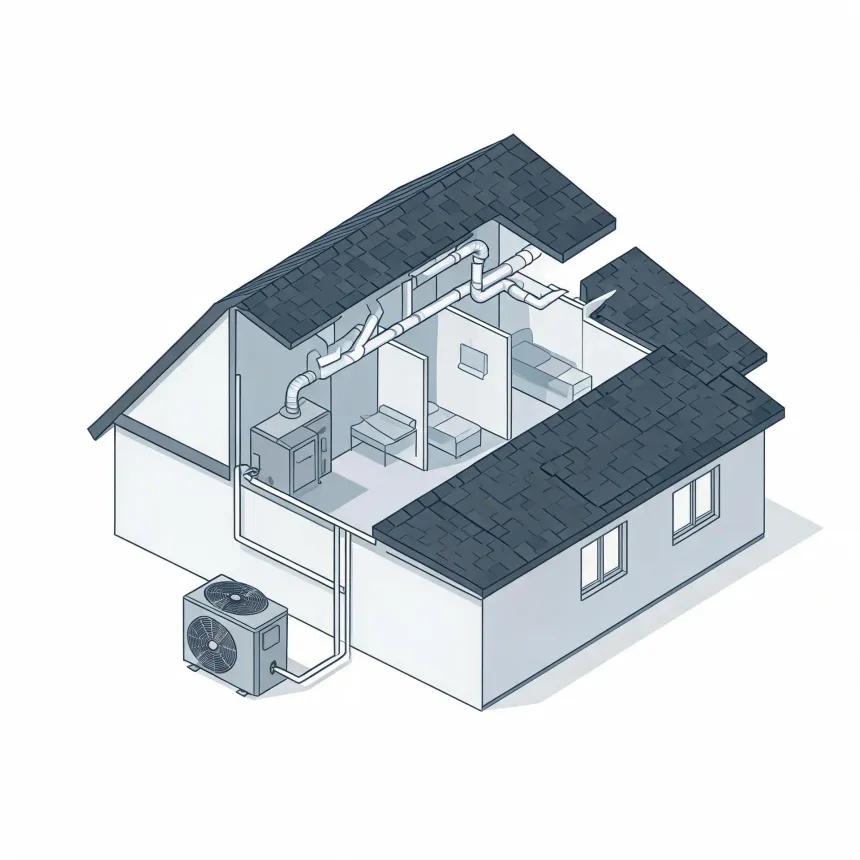
Isometric line illustration of a cutaway single-story house showing interior ductwork, an indoor air handler unit, and an outdoor condenser connected by refrigerant lines, with a dark shingled roof.
Your system heats October through April and cools May through September.

NOAA nClimDiv, 1991–2020 normals

A heat pump fails from a specific worn or faulty part, not from old age all at once.

That's why a repair call usually comes down to finding one bad part, not deciding whether the whole system is done.

Half the homes here were built in 1993 or later, and the heat pump often still has years left in it

Half the homes here were built by 1993
Power here costs 13.96 cents per kilowatt-hour
Climate zone 3A

October is when heat kicks on here, and the first cold mornings are when a weak part finally gets tested. A heat pump that idled through summer with a tired capacitor or a low charge of refrigerant can limp through September without showing it. Once the house needs steady heat instead of occasional cooling, the system has to run longer to hold temperature, and that is when the weak part gives out. Winters here run cold enough, with overnight lows averaging 33°F across December, January and February, that a heat pump stays busy for seven straight months once it starts. A system that acts up in the first weeks of October is worth a look before it settles into daily use all winter.

A mild climate on this machine means a repair is usually the right call

Nothing about Catoosa County's climate puts hard wear on a heat pump. If yours is acting up, the cause is more likely one worn part than a system worn out, and that's a straightforward thing to find and fix.

Find a contractor
A gray outdoor HVAC unit mounted on a concrete pad beside a house with gray lap siding and a stone foundation.

A newer system means repair is the likely answer

Half the homes here were built in 1993 or later, and a system that came with one of those houses is likely still well inside its working life. If yours did, ask the contractor to check the age on the data plate before deciding anything. A heat pump with a lot of years left and one bad part is a repair, not a replacement. That's the ordinary case for this county, not the exception, and it's why the time-lapse here shows a system running day into night with no reason yet to stop.

A small fault turns into a bigger repair

A heat pump that is low on charge keeps running when it should get looked at, and the compressor pays for it. Refrigerant also carries the oil that lubricates the compressor, so a system low on charge is also running that compressor dry. A weak capacitor makes the fan motor or compressor draw harder to start each time, and that heat adds up across the windings. What would have been a capacitor or a metering device becomes a compressor, and a compressor is the one part that can end the system instead of just costing a repair.

Some signs mean stop, not schedule

Ice on the outdoor coil, a breaker that trips more than once, or a burning smell from the indoor unit are reasons to shut the system off and wait for the contractor instead of running it until the appointment. Running an iced coil just restricts airflow further and strains the compressor harder. A breaker tripping is the panel telling you something is drawing too much current, and resetting it to keep the house conditioned risks the part that's failing. A sound or smell that's new is the system telling you plainly before it tells you the hard way.

Before the contractor arrives, there are a few things worth checking yourself. Look at the thermostat first. Make sure it's set to heat, not cool, and that the set point is actually above room temperature. Check the breaker panel for a tripped switch, since a heat pump that won't start at all sometimes just lost power. Go to the outdoor unit and look for anything blocking airflow around it, like leaves or a cover left on. Inside, pull the air filter and hold it up to a light. If you can't see light through it, that filter is choking the system and can bring on problems that look like bigger failures. None of this fixes a bad part, but it rules out the simple stuff before anyone charges a service call.

A repair call usually isn't a guess about the whole system. It's a question about one part, and most parts give some kind of warning before they quit. A capacitor that's weakening will often let the outdoor fan or compressor struggle to start, maybe with a hum before it kicks on. A metering device that's failing will show up as weak heat or weak cooling before it stops the system outright. The parts that fail without warning, like a compressor, are usually the ones that got pushed past the point where an earlier fix would have caught them. That's the real case for having a system looked at when something seems off instead of waiting for it to quit. A heat pump that's heard early almost always comes down to a part, not a decision about the whole unit.