Bartow County sees real storm damage
Bartow County logged 117 severe weather events between 2015 and 2024, including 90 damaging wind events, 12 hail events and 5 tornadoes. Tropical storms reached the county 4 times in that span.
Takes about a minute. No obligation.
Bartow County logged 117 severe weather events between 2015 and 2024, including 90 damaging wind events, 12 hail events and 5 tornadoes. Tropical storms reached the county 4 times in that span.
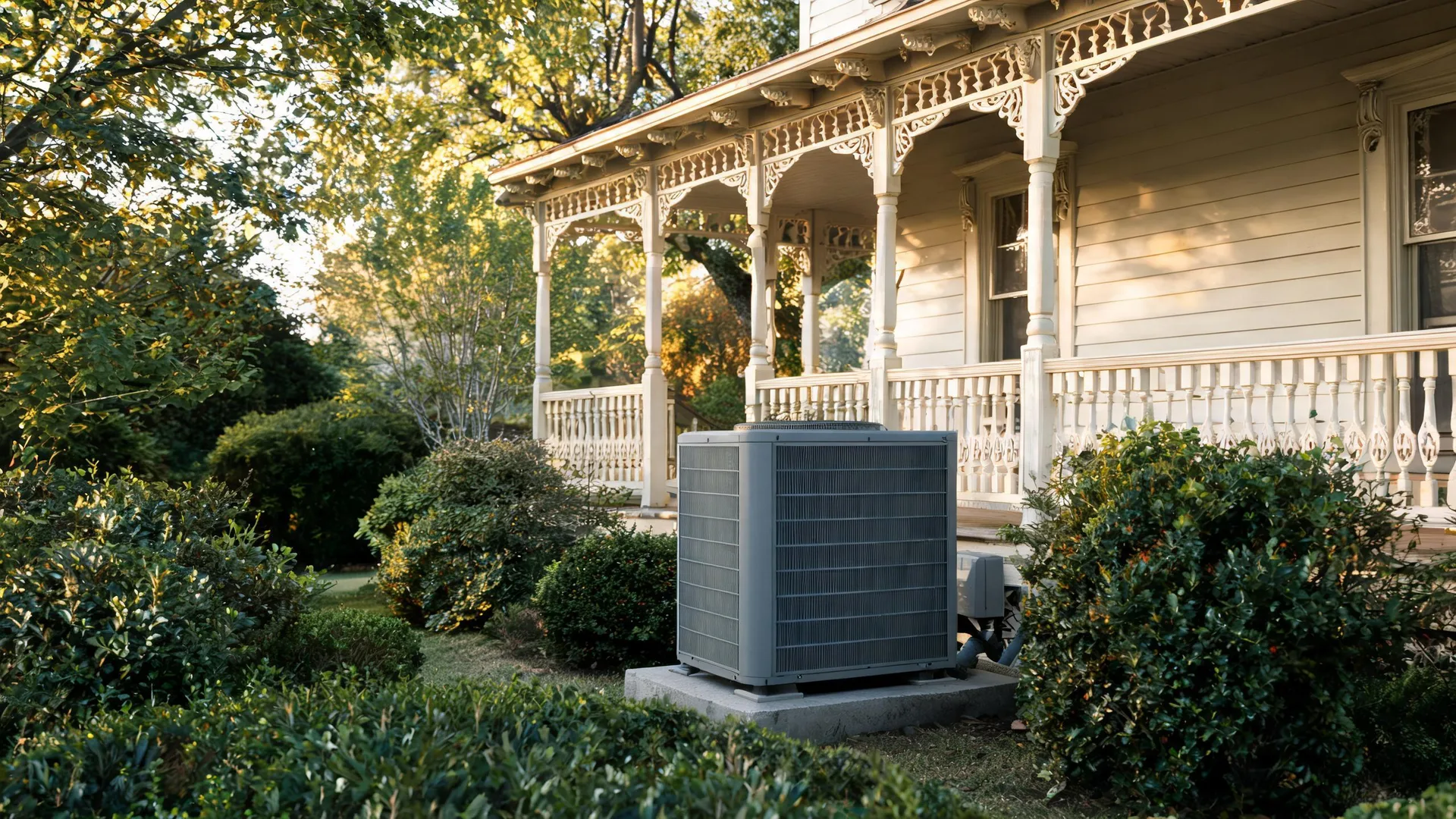
Your heat pump's outdoor unit takes whatever comes across the yard. Wind-driven debris and hail can bend the fins or crack the fan blade without stopping the unit from running. A unit that still turns on after a storm is not the same as one that came through it fine.

NOAA nClimDiv, 1991–2020 normals
Heat here runs October through April, seven months on the heat pump.
September is when a weak part gets found, right before the load hits it.



If the heat pump came with the house, parts are easier to find and a repair is usually straightforward. A system that age hasn't had time to pick up the kind of wear that makes a contractor start talking about replacement instead. That's worth knowing before you agree to anything. Ask what's actually failed before you ask what it costs to fix it, and get a straight answer on whether the part is something they can source quickly or something that has to be ordered.
A heat pump that still turns on after wind or hail isn't the same as one that came through clean. Bent fins or a cracked fan blade can run for a while before they cost you the whole unit. If your outdoor unit has taken a hit this year, get it looked at before it has to work.
Find a contractorBefore anyone comes out, walk outside and look at the outdoor unit. Check that the fan on top spins freely and nothing is jammed against the cabinet or blocking the sides. Pull the air filter and hold it up to a light. If you can't see light through it, that's enough to choke airflow and ice up the coil. Check the thermostat is set to heat and the setpoint is actually above room temperature, and swap the batteries if it's gone blank. Look at the outdoor unit for ice building up on the coil or the lines. Some frost in cold weather is normal, a heavy coat of ice is not. Check your breaker panel for a tripped breaker on the heat pump circuit, and check any disconnect switch near the outdoor unit hasn't been bumped off. If the system is running but the air coming out feels cool rather than warm, that alone doesn't tell you much, heat pumps often put out air that feels cooler than a furnace would even when they're working right. None of this fixes a bad compressor or a refrigerant leak, but it rules out the things that look like a failure and aren't.
A compressor working against low refrigerant or a failing capacitor draws harder each cycle to do the same job. Ice building on the outdoor coil blocks airflow further, so the system runs longer to move less heat. Left alone, a problem that started as reduced output can end with the compressor burning out.
A heat pump that shuts off and restarts every few minutes, instead of running a full cycle, puts a hard start on the compressor each time. That strain adds up faster than normal operation does. The fix is usually a bad sensor, a stuck valve, or a control board issue, and it's worth calling in before a hard start becomes a dead compressor.
A heat pump fails for a handful of reasons, and most trace back to one of a few parts. The capacitor gives the compressor and fan motor the jolt they need to start turning, and it weakens over time until one day it can't. The reversing valve is what switches the system between heat and cooling, and when it sticks, the unit runs but stops doing the job you asked for. Refrigerant leaks show up slowly, a loose fitting or a worn line losing a little at a time, and the system keeps running while it does less and less work. Contactors pit and burn from the current they switch thousands of times, until one day they don't close. None of these announce themselves. They show up as a system that runs longer, blows cooler air than it should, or short cycles instead of holding steady.
A diagnostic visit starts outside at the unit, not with a toolbox. A tech will pull the panel and check the capacitor and contactor first, since those fail often and fail fast to test. From there it's gauges on the lines to check refrigerant pressure, because low charge shows up as a number before it shows up as warm air. They'll run the system in both modes to see if the reversing valve actually switches when it's told to. Electrical readings on the compressor tell them whether it's drawing power normally or straining to do the same work. None of this takes guesswork, the readings point to the failed part directly, which is why a tech can usually name what's wrong before they reach for a replacement.