






A red brick single-story house with a covered porch and adjacent cream-sided houses behind a trimmed hedge and lawn, framed by large oak trees draped with Spanish moss under an overcast sky.

Heat Pump Installation in LaFayette, GA

Tell us about the job

Takes about a minute. No obligation.

New system or replacementHeat PumpWalker County, GA
Step 1 of 2

What ZIP code is the job in?

Electricity heats 75% of the homes in Walker County, which means most houses calling about this already run on it in some form. A heat pump fits that pattern because it still runs on electricity, but it moves heat instead of making it with resistance coils, so it takes the place of an electric furnace or electric baseboard with something that works differently inside. Utility gas only heats 14.6% of homes here, and bottled or LP gas less than that, so for most homeowners this isn't a question of switching away from a gas furnace. It's a question of which electric system replaces the one already in the house. A heat pump also handles cooling, so it stands in for the central air conditioner as well as the furnace.

7 months
October through April, your system heats
5 months
May through September, it cools
33°F
the average winter night it heats against
87°F
the average summer afternoon it cools against
Isometric cutaway illustration of a small house showing interior rooms with furniture, an indoor air handler with ductwork, and lines running to an outdoor condenser unit beside the building.
Your system heats October through April and cools May through September.

NOAA nClimDiv, 1991–2020 normals

Georgia electricity ran 14.08 cents per kilowatthour in 2024.

At that rate a heat pump still costs less to run here than resistance heat, but a pricier high-efficiency model takes longer to earn back the difference.

September is the month to get this done in Walker County

Cooling runs May through September
Heat runs October through April
Climate zone 3A

Walker County gets its share of rough weather, 73 severe weather events recorded over the past decade, most of it wind. None of that calls for a bigger heat pump or a special model. Sizing one comes down to the house, its square footage and how well it holds heat, not the storms outside. Where weather matters more is the power itself. Close to a third of Georgia households went at least 24 hours without power last year, and a heat pump, like any electric system, sits idle during an outage unless the house has backup power. That's a question about the home's power supply, not the unit replacing the furnace.

A standard heat pump fits most homes in Walker County

Half the homes in Walker County went up in 1978 or earlier, half since. Neither end of that calls for anything unusual in a heat pump. A standard size and efficiency fits a house built either decade, as long as it's sized to the square footage. The same goes for the 13.8% of homes here that are mobile homes. That changes how a unit gets installed, not what size or model you need. Get a load calculation done on your own house and size the system to that.

Find a contractor
A man in a dark long-sleeved shirt and tan work pants, seen from behind, carries a canvas tool bag up porch steps toward a blue front door beside a potted shrub.
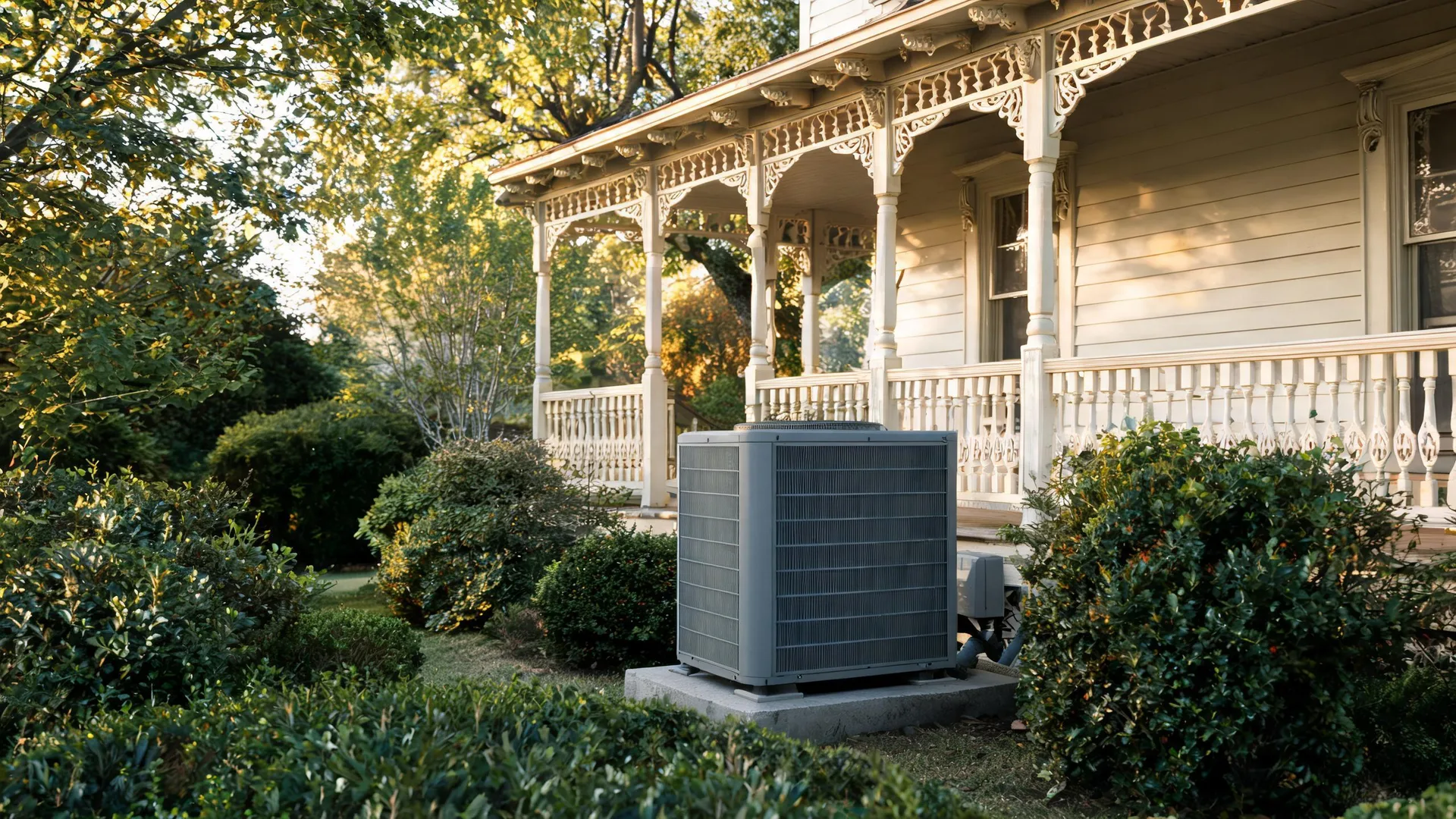
A gray heat pump outdoor unit mounted on a concrete pad next to the stone-accented exterior wall of a house.

What actually sets the price

The unit itself is only part of what you're paying for. Ductwork is the bigger variable. If the ducts already in the house are sized right and sealed tight, a crew pulls out the old system and sets the new one in its place. If the ducts are undersized, leaky, or were built for a gas furnace that pushed air differently than a heat pump does, that's more time and material before the heat pump even gets set. The other driver is the load calculation. A contractor who sizes the system to the actual house, its square footage, insulation, and window exposure, spends more time up front than one who matches the new unit to whatever was there before. That extra time costs something, but it's what keeps the system from running constantly or short-cycling once it's in. Where the outdoor and indoor units go matters too. A straightforward swap, same pad, same closet, same line set run, costs less than a install where the old equipment sat somewhere the new system can't, or where the electrical panel needs work to carry the heat pump's load.

The rating tells you about one unit, not your bill

A higher efficiency rating means the heat pump moves more heat per unit of electricity it uses. That's a fact about the machine, tested under set conditions. What you actually pay depends on the house around it. A well-sealed home with good ductwork gets more out of a given rating than a leaky one does, and the rating alone can't tell you which house you have.
A higher rating usually means more equipment, not just a better coil

Reaching a higher rating often takes a compressor that can run at more than one speed instead of a single fixed speed, sometimes a larger coil, sometimes a blower built to match it. That's more parts working together, which is why higher-rated systems cost more up front and why a contractor needs to size and set them up correctly for the rating to mean anything in practice.

Whoever installs the heat pump also has to deal with what's coming out, and that's not as simple as hauling off a box. The refrigerant in the old system has to be recovered before anything gets disconnected, not vented, because it's against the law to release it into the air. A furnace or air conditioner gets drained and unbolted, but a heat pump has a sealed refrigerant line that a tech has to handle with the right equipment. Once that's done, the indoor and outdoor units, the line set, and the old pad or mounting brackets all come out. If the old system ran on gas, the furnace itself goes, but the gas line to it should get capped off by someone qualified to do that, not left as a loose end. Most of what comes out is scrap metal, and a lot of it gets recycled rather than landfilled.

Install day starts with the old system still running. The crew shuts off power to the furnace or air handler and the outdoor unit before anything gets disconnected, then recovers the refrigerant from the old lines if there's a sealed system involved. Once that's done the indoor coil, the air handler or furnace, and the outdoor unit all come out, along with the old line set and pad. The new outdoor unit goes on its pad, the indoor coil and air handler go in where the old ones sat, and a tech runs new line set between them, then pressure tests it before any refrigerant goes in. Electrical work usually comes next, since a heat pump's air handler often needs a dedicated circuit and sometimes a different breaker than the equipment it's replacing. The system doesn't get charged and fired up until the ductwork connections are sealed and the thermostat is wired in, because running it before that risks damaging the compressor.