Two single-story houses, one with red brick and one with light siding, behind a trimmed hedge and lawn under large oak trees draped with Spanish moss.

Heat Pump Installation in Griffin, GA

Tell us about the job

Takes about a minute. No obligation.

New system or replacementHeat PumpSpalding County, GA
Step 1 of 2

What ZIP code is the job in?

Storms come through Spalding County often

Spalding County logged 110 severe weather events between 2015 and 2024. Most of that was damaging wind, 89 times in that stretch, with 10 tornadoes and 3 tropical storms or hurricanes mixed in. Hail showed up 6 times, and one winter storm made the list too.

Outages follow the storms

Nearly a third of Georgia households went at least 24 hours without power in 2024. A heat pump needs power to run, for heat in the winter and for the compressor outside in the summer. Where the outdoor unit sits and what protects it matters, and so does a plan for getting through a day with no power.

5 months
November through March, your system heats
5 months
May through September, it cools
36°F
the average winter night it heats against
89°F
the average summer afternoon it cools against
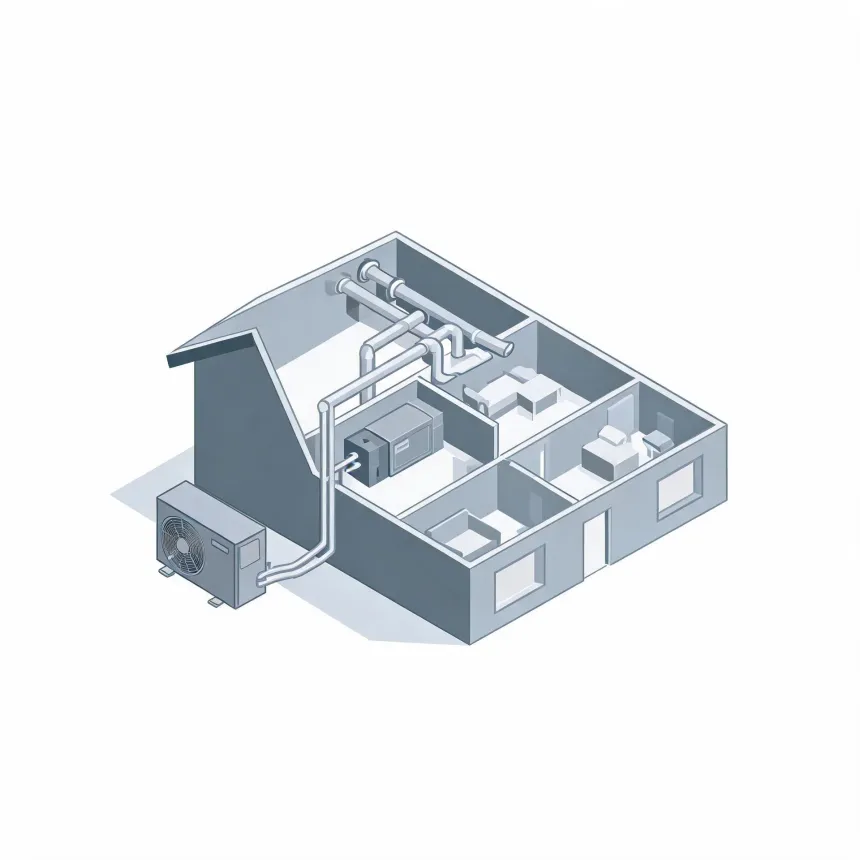
Isometric grayscale illustration of a cutaway house showing interior rooms, ducted air handler and duct runs, connected by pipes to an outdoor condenser unit beside the building.
Your system heats November through March and cools May through September.

NOAA nClimDiv, 1991–2020 normals

Electricity already heats just over half the homes in Spalding County.

A heat pump replacing an electric system drops into wiring and ductwork already built for it.

Power stays cheap here, so paying extra for the highest efficiency model takes longer to earn back

Power here costs 14.76 cents per kilowatt-hour
Climate zone 3A
Cooling runs May through September

Spalding County falls in climate zone 3A, and any split-system heat pump installed here has to clear a federal efficiency floor: at least 14.3 SEER2 for cooling and 7.5 HSPF2 for heat. If the new system is 45,000 Btu/h or larger, central air sold alongside it has to hit at least 13.8 SEER2, since the Southeast standard runs higher than the national minimum. These aren't targets a contractor aims for. They're the lowest a unit is allowed to be before it can go in the ground here. A federal tax credit is available on top of that for equipment that meets certain efficiency thresholds, so it's worth asking which models on your list qualify before you decide.

Plan for the outage before the install, not after

The outdoor unit has to go somewhere that keeps it clear of falling limbs and wind-blown debris. A heat pump also stops heating or cooling the moment the power drops, so it's worth asking what backup options fit your situation before the crew shows up. Settle both during installation and you won't be figuring it out during the next storm.

Find a contractor
A man seen from behind in a gray shirt and tan work pants climbs porch steps toward a blue front door, carrying a worn leather tool bag in his right hand, with a potted shrub in a blue planter beside the door.
A dark gray heat pump unit mounted on a concrete pad next to a house with gray siding and a stone veneer wall.

Put it in before the season needs it

This heat pump runs heat from November through March, then switches to cooling from May through September. April and October are the only months it sits idle either way, which makes them the easiest time to get a new system in the ground. Wait until the system fails on a cold night or a hot afternoon and the crew is working against whatever the weather is doing, not on your schedule. Put it in during April or October and it's ready before the next five-month run starts, not partway through it.

Ask what happens when the power comes back

A heat pump restarts on its own once power is restored, but it doesn't always do it at the same instant. Some units have a built-in delay before the compressor kicks back on, which protects the compressor from short-cycling if power flickers more than once. Ask what that delay is and whether it's adjustable, because a thermostat that's been without power may also need its settings checked.

Ask what the backup heat source is and how it switches over

Most heat pumps pair with a secondary heat source for when outdoor temperatures drop low enough that the heat pump alone can't keep up, or for when the compressor is down. That backup might be strip heat in the air handler or a furnace working alongside the heat pump in a dual-fuel setup. Ask how the system decides when to switch, and whether the backup can run at all if the outdoor unit is damaged or without power.

What a heat pump costs to put in comes down to more than the equipment sitting outside. Sizing drives most of it. A contractor has to work out how much heat the house loses in winter and gains in summer, and that calculation decides the tonnage, not a guess based on square footage alone. Get the size wrong and you either pay for capacity you don't need or end up with a system that runs constantly and still can't keep up. Ductwork is the other big variable. If the existing ducts are the right size and in good shape, the new unit connects to them and that's that. If they're undersized, leaky, or were built for a furnace that moved air differently than a heat pump does, modifying or replacing them adds real labor on top of the equipment itself. Where the indoor and outdoor units go matters too. Longer refrigerant line runs, tricky electrical access, or an air handler that has to move to a new spot all add work a straightforward swap wouldn't need.

Efficiency still matters here, but it's not the only thing worth paying for. Since running cost plays a smaller part in the payoff, put more weight on how the system holds up when the grid doesn't. A unit with a lower efficiency rating but a sturdier cabinet, better placement, and a solid backup plan is worth more here than one that shaves a few dollars off a summer bill. Ask the contractor what each model is built to withstand before you ask what it will save you. That's the better question in a county where the power is the bigger risk, not the rate.