Five months of work a year
Furnaces in Henry County run from November through March, and the overnight low only averages 35°F even in January. That's a mild load compared to what a furnace handles further north.
Takes about a minute. No obligation.
Furnaces in Henry County run from November through March, and the overnight low only averages 35°F even in January. That's a mild load compared to what a furnace handles further north.
A furnace that never has to fight hard tends to hold up well through the years. If yours is acting up now, age or a worn part is more likely the cause than years of strain, and that usually makes it worth fixing.
NOAA nClimDiv, 1991–2020 normals
Half the homes in Henry County were built in 2001 or later.
A furnace that came with a newer house usually still has years left in it.



If your furnace is original to the house, there's a good chance it still has years of service left. That's worth knowing before you decide whether a repair is the right call.
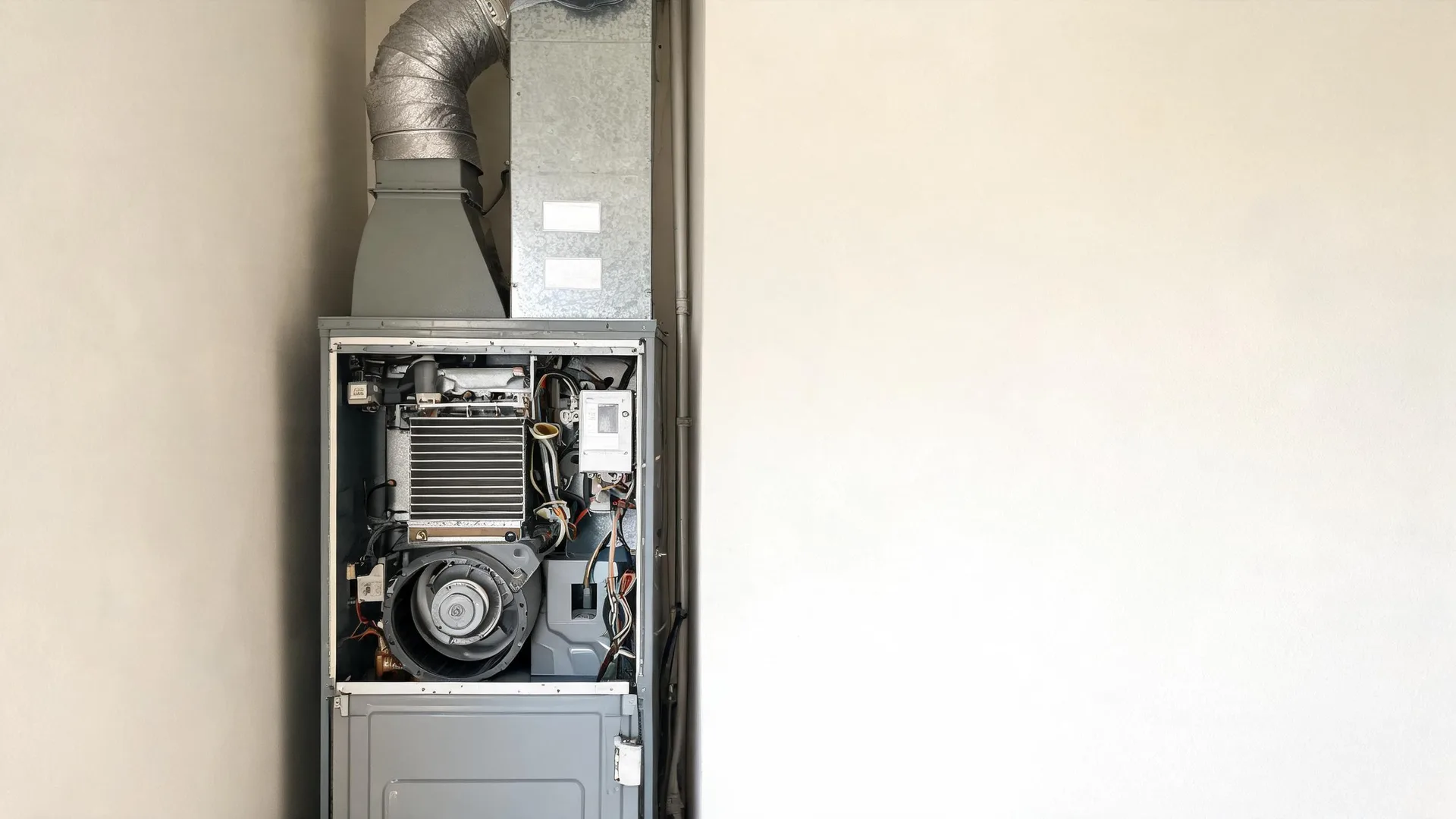
Find a contractorMost furnace failures trace back to one of a handful of parts. The igniter wears out from heating and cooling every time it fires, and eventually it cracks or stops glowing hot enough to light the gas. The flame sensor gets a film of oxidation on it over time, and once that builds up, it can't tell the furnace a flame is there, so the system shuts itself down as a safety measure. The inducer motor runs every cycle to clear the exhaust, and like any motor, its bearings can wear out. Capacitors that start the blower motor lose their charge with age and stop kicking the motor on. None of these fail because a furnace works too hard. They fail because they've opened and closed, heated and cooled, started and stopped thousands of times.
A cracked heat exchanger or a failing flame sensor can still let the furnace limp along for a while. Keep running it and a small crack can spread, or the soot and heat that caused the first problem start affecting the parts around it, like the limit switch or the blower control board.
Once a furnace is cycling on its limit switch, short-cycling, or tripping its flame sensor repeatedly, each cycle puts the same stress on the ignition system and the blower motor that caused the first failure. Shutting it off and calling for repair stops that from spreading to parts that were fine yesterday.
Estimates for a typical Henry County home, compared with an older unit built to the previous federal minimum, from EIA household energy data, Georgia fuel prices and NOAA climate normals. Your home will differ.
Repair makes sense when one part has failed and the heat exchanger is sound.
Replacement makes sense when the heat exchanger is cracked or the furnace keeps needing parts.
A repair usually makes sense if the furnace is heating fine otherwise and the failed part is something that just wears out on its own, like an igniter or a flame sensor. Swap the part and the furnace is back to normal, because nothing else was wrong with it. Replacement starts to make more sense when the heat exchanger is cracked, since that part isn't sold on its own and isn't meant to be. It also makes sense when the same failure keeps coming back after being fixed, which usually means something else is driving it, like a blower motor that's weakening and overheating the parts around it. A tech can tell you which case you're in by looking at what actually failed and why, not just by how old the furnace is.