





Night view of illuminated white Southern-style houses with wraparound porches beneath Spanish moss-draped oak trees.

Furnace Installation in Stockbridge, GA

Tell us about the job

Takes about a minute. No obligation.

New system or replacementFurnace or heatingHenry County, GA
Step 1 of 2

What ZIP code is the job in?

Gas heats a little more than half the homes in Henry County, with electricity close behind at 46.2 percent. If your house already has a gas line run to a furnace, putting in another gas furnace is usually the straightforward choice. The contractor will size it to your house and check the venting and gas line before anything goes in. If your home heats with electricity instead, that's worth saying up front, since the installation looks different.

5 months
November through March, your furnace is on duty
35°F
the average winter night it heats against
51%
of homes here heat with gas, so most furnaces here burn gas
80% AFUE
the federal minimum any new unit must meet
Isometric line illustration of a cutaway single-story house showing interior rooms with furniture, ceiling ductwork, a chimney flue, and a furnace unit outside the exterior wall.
Your furnace works hardest from November through March.

NOAA nClimDiv, 1991–2020 normals

Furnaces in Henry County start running in November.

Put yours in during October and it's ready before you need it, not after.

Henry County's weather is the reason for backup power, not a bigger furnace

62 severe weather events from 2015 to 2024
31% of homes statewide lost power a day or more in 2024
50 damaging wind events from 2015 to 2024

Your furnace here only has to work about five months a year, November through March. Overnight lows average 35°F in December and January, which is cold enough to run the heat but nowhere near what furnaces in colder states are built to handle. That's a short season and a mild one. A mid-range furnace sized right for your house will keep up with it fine. You don't need to pay for the highest efficiency tier or the biggest unit on the lot to stay warm here.

Replace it before the season

Replace it before the season starts, so it happens on your schedule, not in a hurry.

Find a contractor
A gas furnace with attached ductwork, gas piping, and condensate lines installed in a concrete-block basement.

What happens to the furnace you're replacing

The old furnace doesn't get hauled off on day one. It runs the new one's final safety check, then the installer shuts off its gas valve and disconnects the line. If it's a natural draft unit sharing a flue with the water heater, that flue gets resized, since the old furnace was likely doing most of the work keeping the draft moving. Skip that step and the water heater can end up backdrafting. The old ductwork usually stays, but it gets checked for leaks and connections sized for the new blower before the furnace itself is pulled out.

The ductwork decides more than the furnace does

If the existing ducts are too small or leaky for the new blower, the installer has to fix that before the furnace can run right. Sealing joints, adding a return, or resizing a trunk line is real labor on top of the unit itself. A furnace that's sized perfectly but feeding bad ductwork won't heat the house evenly no matter what it cost.

Venting changes the job, not just the price

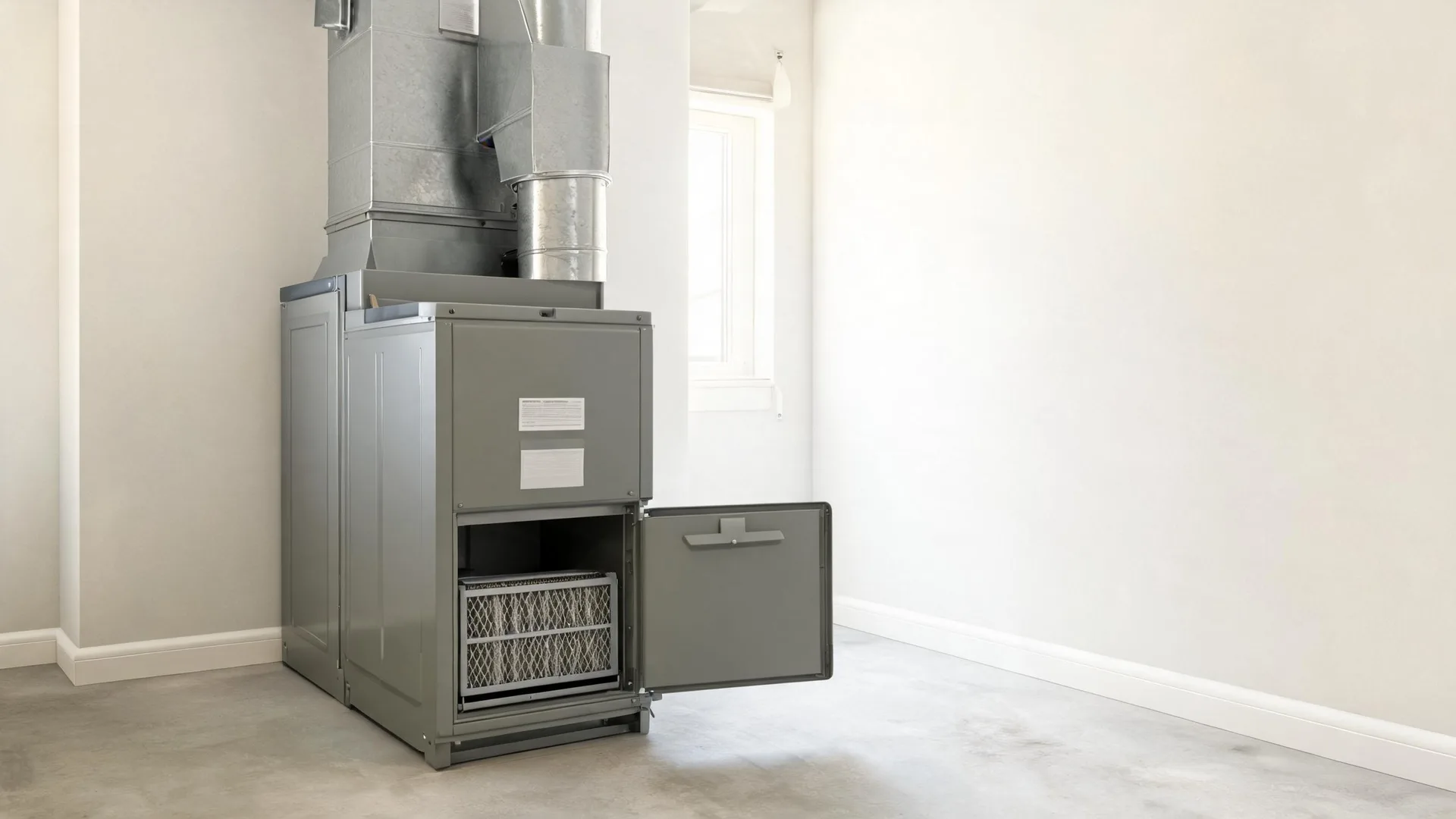
A high-efficiency furnace vents through PVC pipe out a sidewall, not up a flue. That means new venting has to be run, sometimes through a wall or up through the roof, and a condensate line has to drain somewhere. A furnace that vents the old way through a shared flue is simpler to install but comes with the flue-sizing work already mentioned. Which type fits depends on what's already there, not just which furnace you pick.

An unfinished basement featuring concrete block walls, exposed floor joists, and a metal forced-air furnace with ductwork near a central pillar.

A high-efficiency gas furnace would save about $110 a year to run in Henry County compared with a gas furnace.

  • A high-efficiency gas furnace$540 a year
  • A gas furnace$650 a year

Estimates for a typical Henry County home, from EIA household energy data, Georgia fuel prices and NOAA climate normals. Your home will differ.

Installation day starts with the old furnace coming out and the new one going in roughly the same footprint, so the supply and return connections line up. Once it's set, the installer runs gas to it, connects the vent, and wires it into the thermostat and the blower circuit. Then comes the testing, and that's the part that actually takes the time. Gas pressure gets checked and adjusted at the manifold, since factory settings aren't always right for every house. The installer checks temperature rise across the heat exchanger against the range printed on the furnace's own data plate. If it's outside that range, something's off with airflow or gas input, and it gets corrected before they leave. Flue gas gets tested for carbon monoxide, and the blower gets checked on each speed tap. A furnace that fires up but hasn't been tuned to the house it's in will run inefficiently or unsafely, and the only way to catch that is to measure it, not guess.