The furnace running clean
This is what a healthy setup looks like: sealed flue pipes carrying exhaust outside, the gas line feeding the burner steady, and ductwork pulling warm air through the house with nothing else mixed into it.

You caught a strange smell near the furnace, or maybe a headache that only shows up when it's running. Before you call anyone, you want to know what you're actually dealing with and whether it's serious enough to act on now. A cracked heat exchanger is one of the few furnace problems that's worth taking seriously right away, not something to watch for a season.
The metal in a heat exchanger expands when the furnace runs and contracts when it shuts off, and that's when you'll hear a ticking or clicking noise coming from the cabinet. A crack lets the flame burn unevenly, so instead of a steady blue flame you'll see it waver or turn yellow. Soot building up around the burner compartment is another sign, since a cracked exchanger can disrupt the draft that normally carries exhaust up and out. Georgia homes that heat with electricity may have a furnace that runs less than gas systems elsewhere, but any of these signs means the exchanger needs to be checked before you run the furnace again.

A furnace burns gas inside the heat exchanger and that exhaust is supposed to stay sealed off from the air blowing through your house. Once metal cracks from the heating and cooling it goes through every cycle, exhaust gas can mix with the air the blower pushes into your rooms. That includes carbon monoxide. A crack can be too small to see without the furnace taken apart and a camera run through it.

Most homes here heat with electric systems, but if your furnace runs on gas, a technician testing for this will run it with panels off and check for carbon monoxide right at the supply vents, not just near the unit. A flame that flickers or changes shape once the blower kicks on is another sign, since air leaking through a crack pushes against the burner flame. Soot around the burner compartment points the same direction.

Most homes in Georgia heat with electricity, so your furnace may only run on the coldest days. That can make a cracked heat exchanger harder to catch, since you're not standing near it every day the way someone running a furnace all winter would. A soot smell or a headache that clears when you leave the house is worth paying attention to the next time the temperature drops and it kicks on.
If you're already the type to check on something small before it becomes a bigger problem, this is one you don't want to wait out. Finding a furnace contractor, explaining the smell and when it happens, and sorting through quotes takes time you'd rather not spend on something that affects the air in your house. Send the form once and that search is off your plate.

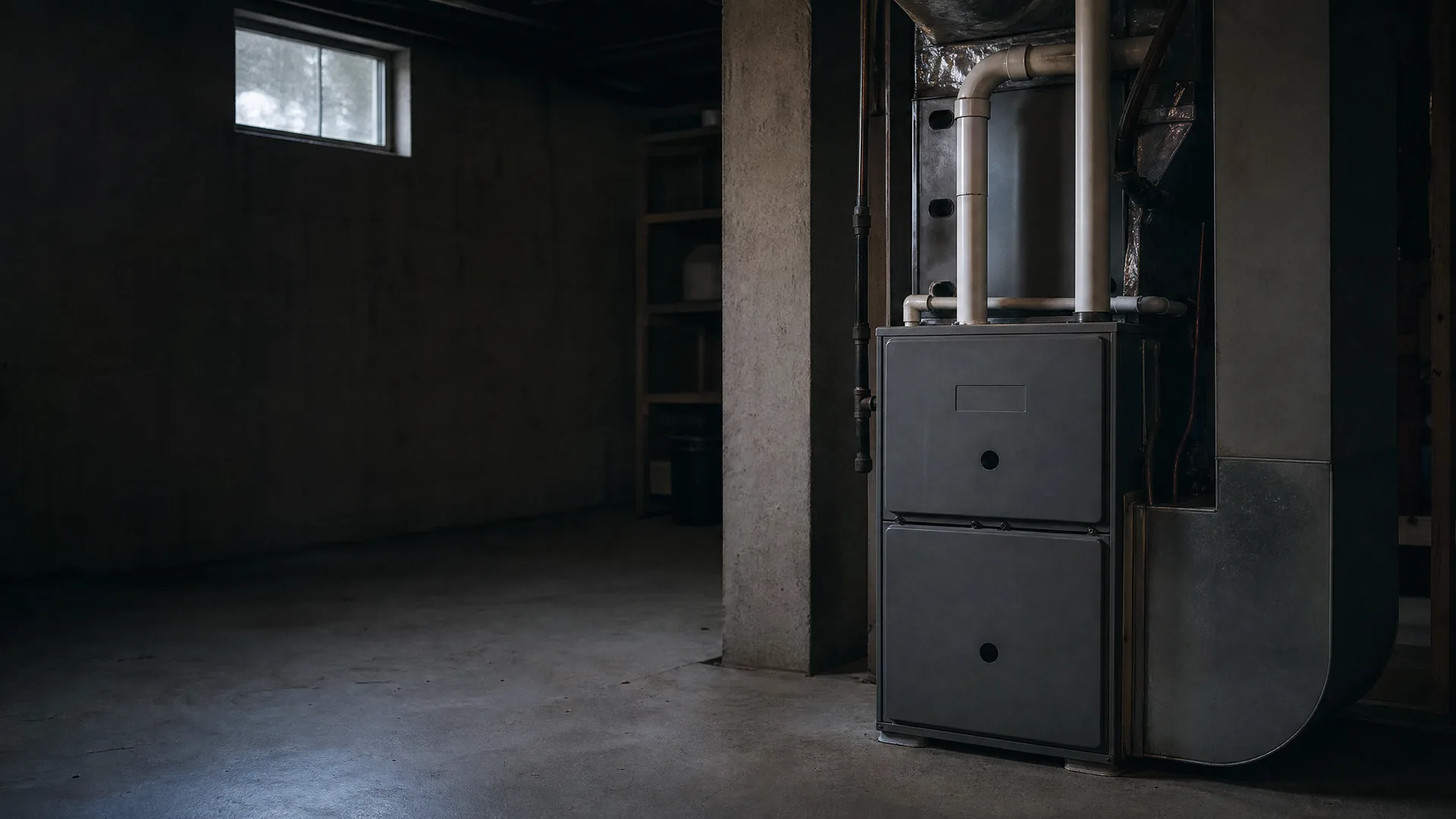
You go down to check the thermostat setting before bed and the basement is colder than the rest of the house. It's a November evening, dark outside already, and the furnace sits there with no hum, no blue light at the burner. You flip the switch at the unit and nothing happens. A thin haze hangs in the air near the cabinet, the kind that settles when something's been sitting unused and gets disturbed. You crouch down and look at the access panel, not sure what you're looking for, just sure you don't want to turn it back on until you know. The house is quiet. The furnace stays dark.
Explain the job once and skip repeating it on every call.
Sending the form costs nothing.
Once you suspect a cracked heat exchanger, you have two options while you wait for a repair. You can keep running the furnace on cold nights, or you can shut it off and use space heaters until someone looks at it. Running it keeps you warm, but every cycle pushes more exhaust through whatever gap is in the metal, and that gap doesn't close on its own. Carbon monoxide has no smell on its own, so you won't get a warning before it's already in the air you're breathing.
Turning the furnace off is the safer choice, and in Georgia, where it may only run on the coldest days anyway, going without it for a stretch is more realistic than it would be somewhere colder. Space heaters can cover a room or two, but they won't heat the whole house the way your furnace does, and running several of them adds to your power bill. Either way, a cracked heat exchanger doesn't fix itself with time off. The metal stays cracked until a contractor replaces the exchanger or the furnace, so shutting it down buys you safety, not a solution.


You keep running the furnace because it's October and the house is cold, and you figure a few more nights won't matter until someone can look at it.
A cracked heat exchanger doesn't heal on its own, and every cycle it runs is another chance for exhaust gas to mix with the air moving through your house.





This is what a healthy setup looks like: sealed flue pipes carrying exhaust outside, the gas line feeding the burner steady, and ductwork pulling warm air through the house with nothing else mixed into it.

Same kind of unit, same ductwork overhead, but this is the one someone's called about. A crack in the heat exchanger doesn't show on the outside. You won't see it sitting on its pallet in the basement. You'll see the symptoms instead, or you won't see anything at all until a tech pulls it open.




With over half of Georgia homes heating with electricity, your furnace likely sits unused for long stretches between cold snaps. A crack can form and keep leaking exhaust through every one of those short runs without anyone noticing, since there's no daily routine of standing near the unit to catch a smell or a headache early.
ACS 2020-2024 5-year B25040
Metal in the heat exchanger expands and contracts every time the burner fires.
Repeated cycles stress one spot until a thin crack opens in the metal.
Blower air flows past that crack as it moves through the duct system.
Exhaust gas slips through the crack and mixes into the air headed for your rooms.
A cracked heat exchanger doesn't announce itself. It's a smell near the furnace, a headache that fades when you leave the house, rust on the cabinet, soot where there shouldn't be any. None of those prove a crack by themselves, and that's exactly why it's worth having someone check rather than guessing from the basement stairs. Once you send the form, you're done with the part that eats the most time: searching for a furnace repair contractor in Georgia, calling a few, explaining the smell and the rust and the headache to each one, then sitting with their quotes trying to figure out who actually knows what they're looking at. That work goes to someone else. You still need the furnace opened up and the exchanger inspected before anyone can tell you for certain what's wrong with it, and that part takes the time it takes. But you're not the one tracking down who can do it. You already know the signs. What's left is getting a contractor in front of your furnace to confirm or rule it out.




Skip searching for a furnace pro and answer a few questions instead.
You're not committing to anything by asking.