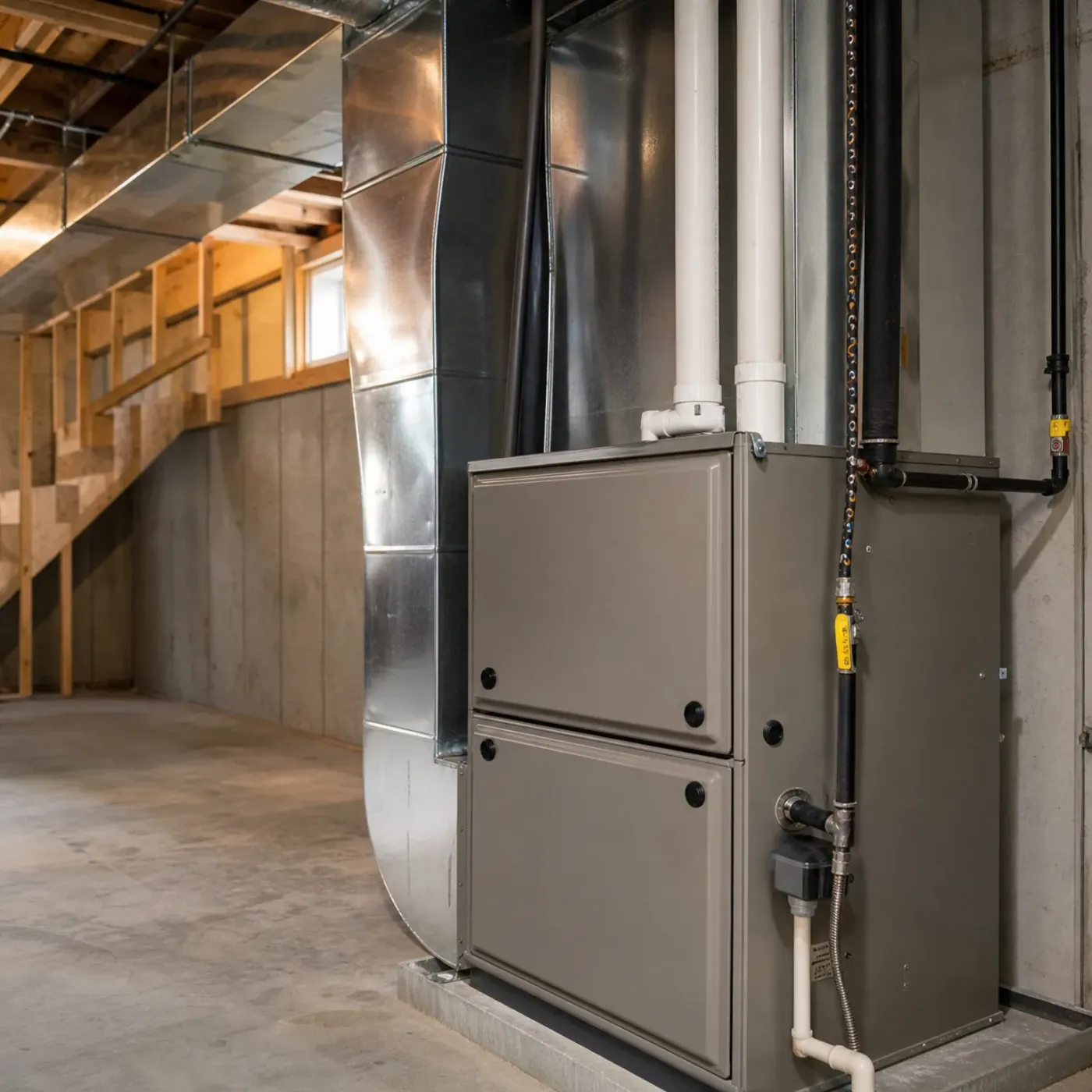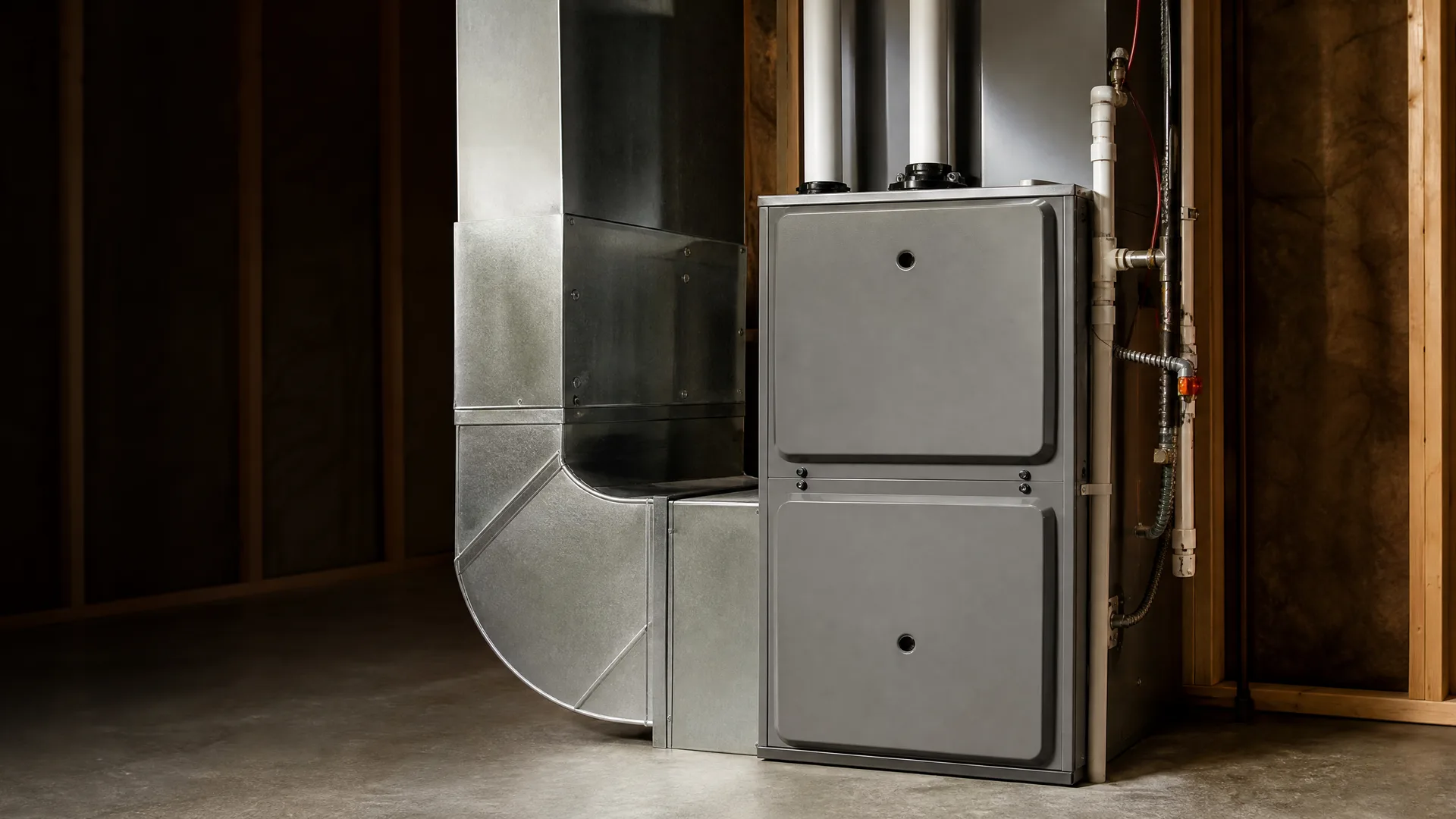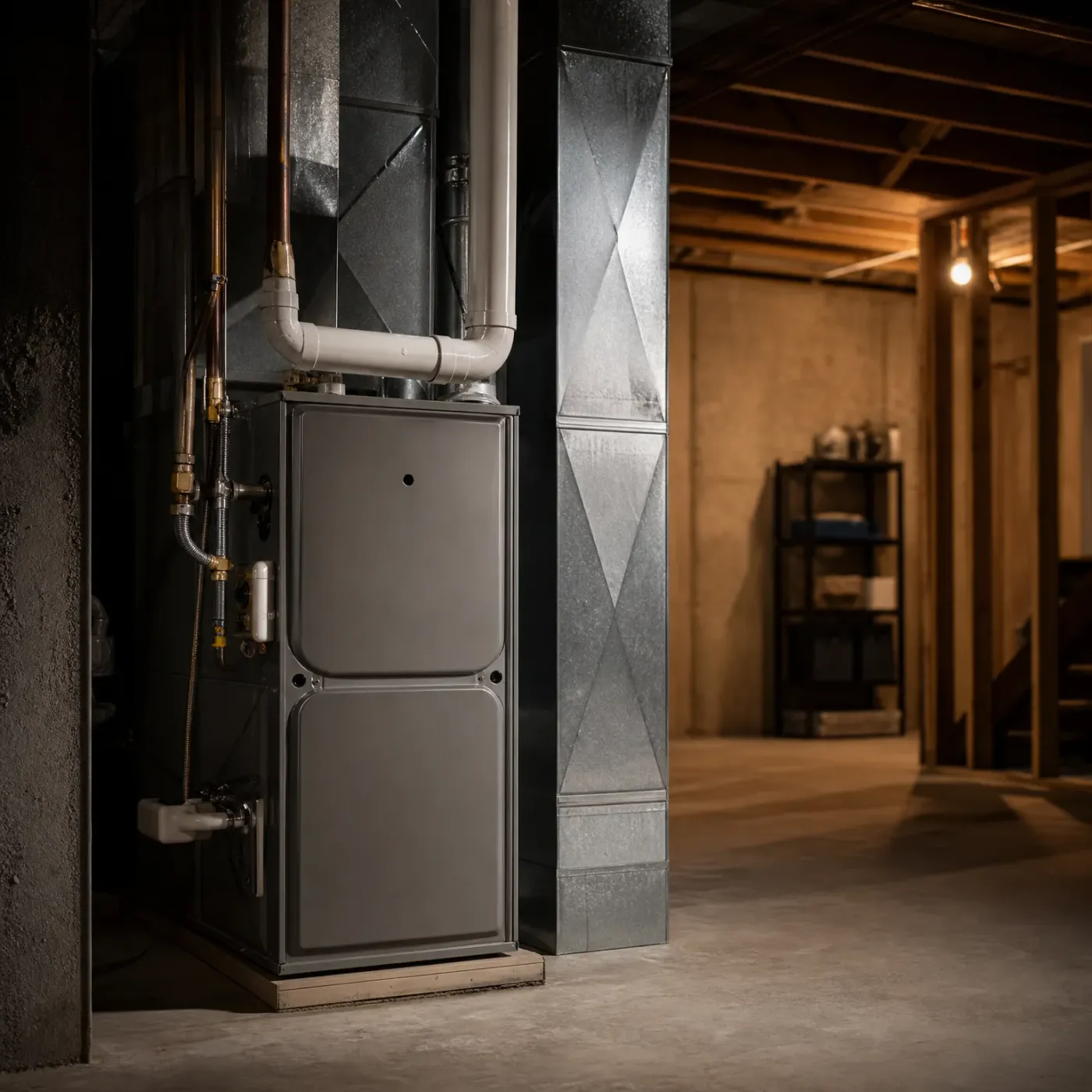







A gray gas furnace with copper and PVC piping stands beside large galvanized sheet-metal ductwork in an unfinished basement with concrete floor, wood framing, and a glowing bare bulb in the background.

Finding a pro stops being your job

Furnace won't turn on in Cumming, GA

A furnace that won't start is usually telling you something specific, whether that's the thermostat, the igniter, the pilot, or a safety switch that tripped. This page walks through what to check first and what it means when none of it works. When you're ready to hand it off, send the form and let a licensed Forsyth County contractor take it from there.

Hand it off

A furnace that won't turn on is almost always stopping at one point in the startup sequence. The thermostat calls for heat, the system checks a run of safety switches, then the igniter or pilot lights the burners and the blower pushes warm air through the ducts. If any one of those steps fails, the furnace shuts itself down rather than risk running unsafely. The most common stop is the igniter, which wears out with age and simply stops glowing hot enough to light the gas. A flame sensor coated with a thin layer of residue can also tell the system no flame is present even when one started, so it shuts the gas back off. A tripped limit switch, a clogged filter blocking airflow, or a drain line backed up on a high-efficiency furnace can all do the same thing. In Forsyth County, where most homes heat with gas and winters get genuinely cold, a furnace that won't start is not something to leave for a mild stretch of weather. It needs a look from someone who can tell which step in that sequence is actually failing.

A woman with long light-brown hair in a gray knit sweater sits in a living room looking off to the side, with a sectional sofa, houseplant, lamp, wooden table and large windows behind her.
A woman in a chunky gray turtleneck sweater sits indoors looking off to the side, with a blurred dining table, chairs, pendant lamp and window behind her.
A woman in a cream knit sweater with her hair in a bun stands near a window, looking off to the side, with a gray sofa, houseplant and open kitchen with pendant lights blurred behind her.
A woman with long brown hair in a cream knit sweater stands near a window, looking to the side, with a white sofa, shelving, and a hallway visible behind her.

A furnace fires in a set order, and it only moves to the next step if the one before it checks out. The thermostat sends a signal to the control board first. No signal, no start, which is why a dead battery or a dark thermostat screen can look like a bigger problem than it is. From there the board reads through its safety switches. The door switch has to be closed, the limit switch has to show the furnace isn't overheating, and if either one is open the board stops and waits. Next the inducer motor has to spin and prove it's clearing the vent before any gas is allowed to flow. Then comes ignition, either a hot surface igniter glowing hot enough to catch the burners or, on an older furnace, a thermocouple confirming a pilot flame within seconds. Last is the blower, and it holds off until the heat exchanger has warmed up, so a furnace that's actually lit can still feel like it's doing nothing for a short while.

The startup sequence, step by step

  • The thermostat has to send a low-voltage signal to the control board before anything else happens, so dead batteries or a blank display stop the whole sequence right there.
  • The control board checks a row of safety switches, including the door switch and the limit switch, and if any one is open it won't send power to the igniter.
  • A hot surface igniter draws current and glows before it can light the burners, and a cracked or weak igniter is a common reason the burners never catch.
  • If your furnace has a standing pilot, the thermocouple has to sense that flame within seconds or it shuts the gas valve to stop unburned gas from escaping.
  • The inducer motor has to spin up and prove it's pulling exhaust through the vent before the control board allows the burners to light.
  • Once the burners are lit, the blower waits for the heat exchanger to warm up before it turns on, so a furnace can light and still feel like nothing's happening.
A gray high-efficiency furnace stands on a concrete basement floor beside galvanized sheet-metal ductwork, white PVC vent pipes, copper and black piping, and unfinished wood stud framing.
A furnace running right stays quiet, cycles on its own schedule, and sends warm air through every vent without you thinking about it.
A gray furnace with two access panels stands on a concrete basement floor beside sheet-metal ductwork, with pipes, flexible conduit and an electrical box on the concrete wall to the left.
A furnace like this, dark panels and no sound from the blower, means the startup sequence stopped somewhere before ignition.

Is this why your house feels colder than it should?

You've probably noticed the thermostat says 70 but the air coming from the vents is cold, or there's no air moving at all. Maybe you heard a click or two and then nothing, or the blower runs but no heat follows it. Some houses pick up a faint gas smell near the furnace, which means stop and call for help rather than keep testing the thermostat. Left alone on a cold night, a furnace that won't fire means the house keeps losing heat it can't replace, and that gets harder on anyone with young kids or older family members trying to stay warm until it's fixed.

A gray high-efficiency furnace with white PVC vent pipes stands beside sheet-metal ductwork and a water heater in an unfinished basement with concrete walls and wood framing.

Running the way it should

A furnace like this starts on its own when the thermostat calls for it, runs through its checks, and lights without a fight. The flue pipes stay clear, the ductwork carries heat to every room, and you don't hear a thing from the basement beyond the normal hum.


A beige gas furnace with a metal flue pipe stands in a basement against concrete block walls, beside sheet-metal ductwork, copper and white plastic pipes, and a water heater at right.

Stopped short

An older furnace like this has more places for the startup sequence to catch. A weak flame sensor, a cracked heat exchanger, or wiring that's loosened with age can all stop it cold. Galvanized duct joints and old connections are worth a look too.

Fix It Yourself or Call Now

Call for repair

  • The furnace has dead panels, no blower sound, and nothing changes no matter how many times you adjust the thermostat.
  • You've checked the thermostat batteries and the breaker, and the furnace still won't respond.
  • A gas furnace that won't light at all shouldn't be forced to keep trying, since repeated ignition attempts without a flame can trip the system into lockout.
  • A furnace that was working fine last week and now does nothing points to one failed part, not a system in decline.
  • Cold weather in Forsyth County doesn't wait, and a furnace that's fully down needs someone who can find the stuck switch or failed igniter and get it running again.

Keep troubleshooting first

  • If the thermostat display is blank, swapping the batteries is worth trying before anything else.
  • A furnace that stops because a door isn't latched will start again as soon as the panel is seated and the switch clicks shut.
  • If the breaker tripped, resetting it costs nothing and solves the problem in some cases outright.
  • A blower that runs but produces no heat is a different problem than a furnace that won't start at all, and it's worth knowing which one you have before you call.
  • Checking that the thermostat is actually set to heat, and set above room temperature, takes a minute and rules out the simplest cause.
A beige high-efficiency furnace in an unfinished basement, with white PVC vent pipes, a yellow gas line, metal ductwork, and exposed wood framing on a concrete floor.

Working the way it should

A furnace like this starts when the thermostat calls for heat, runs its safety checks, and lights without hesitation. The exhaust pipe vents outside, the ductwork carries warm air to every room, and the burners fire the same way each time you need them.

An older beige furnace with two louvered vent panels stands on a concrete basement floor, connected to galvanized ductwork and a metal flue pipe, with gas piping and flexible conduit on the wall behind.

Stuck before ignition

An older furnace like this can fail at the same points a newer one does: a cracked heat exchanger, a flue blocked with rust or debris, a pilot that won't stay lit. If the panels are dark and the blower stays quiet, the startup sequence stopped somewhere before the burners ever fired.

A woman with dark hair in a bun sits on a grey couch holding a sleeping child wrapped in a knit blanket, with a lit lamp and potted plant blurred in the background.
An older woman with grey-blonde hair in an updo and a beige turtleneck sweater smiles while looking to the side in a warmly lit kitchen, with a round loaf of bread on the counter in front of her and a dark window showing snow outside.
A gray high-efficiency furnace in an unfinished basement, connected to large galvanized sheet-metal ductwork, PVC vent pipes, a gas line and flexible conduit, with concrete walls, wood framing and a staircase in the background.

Let someone else find the pro

A licensed pro who repairs furnaces in Forsyth County gets your request.

Send the request today and stop worrying about who to call.

Find a licensed furnace pro

You're not committing to anything by asking.

An older gas furnace with two louvered front panels stands on a concrete basement floor beside galvanized sheet-metal ductwork, pipes, and a weathered concrete wall.
Before you get your furnace repair
A gray high-efficiency furnace in a basement, connected to sheet-metal ductwork on the left and white PVC vent pipes above, with black gas and drain piping and an exposed wood-stud wall with OSB sheathing on the right.
After you get your furnace repair

Why gas furnaces have a lockout

Most gas furnaces will try to light three times before the control board gives up and locks itself out. That's not a flaw, it's the board protecting you from a burner that keeps failing to catch. If the igniter is weak or the flame sensor is dirty, the furnace can run through the whole sequence over and over without ever producing heat. Once it locks out, cycling the thermostat usually won't reset it. Some boards need the power cut at the switch or breaker for a minute before they'll try again.

Why cold snaps expose old parts

A furnace can run fine for months and then fail the first hard freeze of the season. Forsyth County winters put more demand on a system than it sees the rest of the year, and a part that was already marginal, an igniter near the end of its life or a flame sensor with a light coating on it, often fails under that extra load rather than during a mild stretch. If your furnace sat unused for months before it had to run flat out, a sudden no-start on a cold night is often the first real sign something was already wearing out.

Winter nights average 33°F

A 33°F night here means your furnace is firing up well before sunrise and running long after dark. When it won't start on a night that cold, the house loses heat fast, and a tripped switch or a weak igniter stops being something to put off.

NOAA nClimDiv 1991-2020

A furnace that locks out after three failed tries can be reset once by cutting power at the switch or breaker for a few seconds, then turning it back on.

If it lights and then locks out again, resetting it again won't fix what stopped it. That's a furnace repair call, not something to keep resetting on a cold night.

Why does your furnace need to work so hard here in winter?

  • Winter nights average 33°F

    Overnight lows average 33°F from December through February, so your furnace is cycling on through the coldest part of the night, not just a few chilly evenings.

  • Heat runs October through April

    Heat runs here from October through April, about seven months a year. A furnace that won't start isn't an inconvenience you can wait out.

  • 68.7% of homes heat with gas

    Most homes in Forsyth County heat with gas, 68.7% of them. If yours is one, the startup sequence runs through an igniter or pilot before any heat reaches the vents.

NOAA nClimDiv 1991-2020 · ACS 2020-2024

Where this leaves you

  • A furnace that won't start is stuck at one point in the thermostat, safety switch, or ignition sequence.
  • Resetting power once can clear a lockout, but a repeat lockout means something tripped it in the first place.
  • A furnace technician working in Forsyth County through winters like this one has seen most of what causes this and checks it in order.
  • One licensed local contractor takes the call, so you're not fielding quotes from four different companies while the house gets cold.
  • Cold nights in the 30s mean the furnace is already working through the night, and a stopped startup won't fix itself by morning.
  • Once you send the request, finding the right contractor stops being your problem to solve.

The furnace stopped somewhere between the thermostat call and the burners lighting, and almost always that point can be found and fixed. A dead panel means the sequence never started. A lockout after three tries means it started and failed on purpose, which is the board doing its job. Either way, the fix is usually smaller than a cold house makes it feel at five in the morning.

What you need now is someone who already knows the order to check things in, because they've been doing it all winter on furnaces like yours. A technician working Forsyth County through a season of 33°F nights has seen the same igniter and the same pressure switch fail more times than they can count, and they check the likely things first instead of guessing. That's the difference between a service call that takes one visit and one that takes three.

Sending the request connects you with one licensed local contractor, not a list of four companies competing for the job. You make one call's worth of decisions, not five. From there, it's the contractor's job to find what stopped the furnace and get it running again, and that stops being something you have to figure out on your own.

The house is already losing the heat it had. The sooner the startup sequence gets looked at, the sooner the vents are warm again.

A gray high-efficiency furnace with two white PVC vent pipes stands in an unfinished basement beside galvanized sheet-metal ductwork, with insulated wood-framed walls and piping behind it.

One request and it's handed off

RepairFurnace or heatingForsyth County, GA
Step 1 of 2

What ZIP code is the job in?