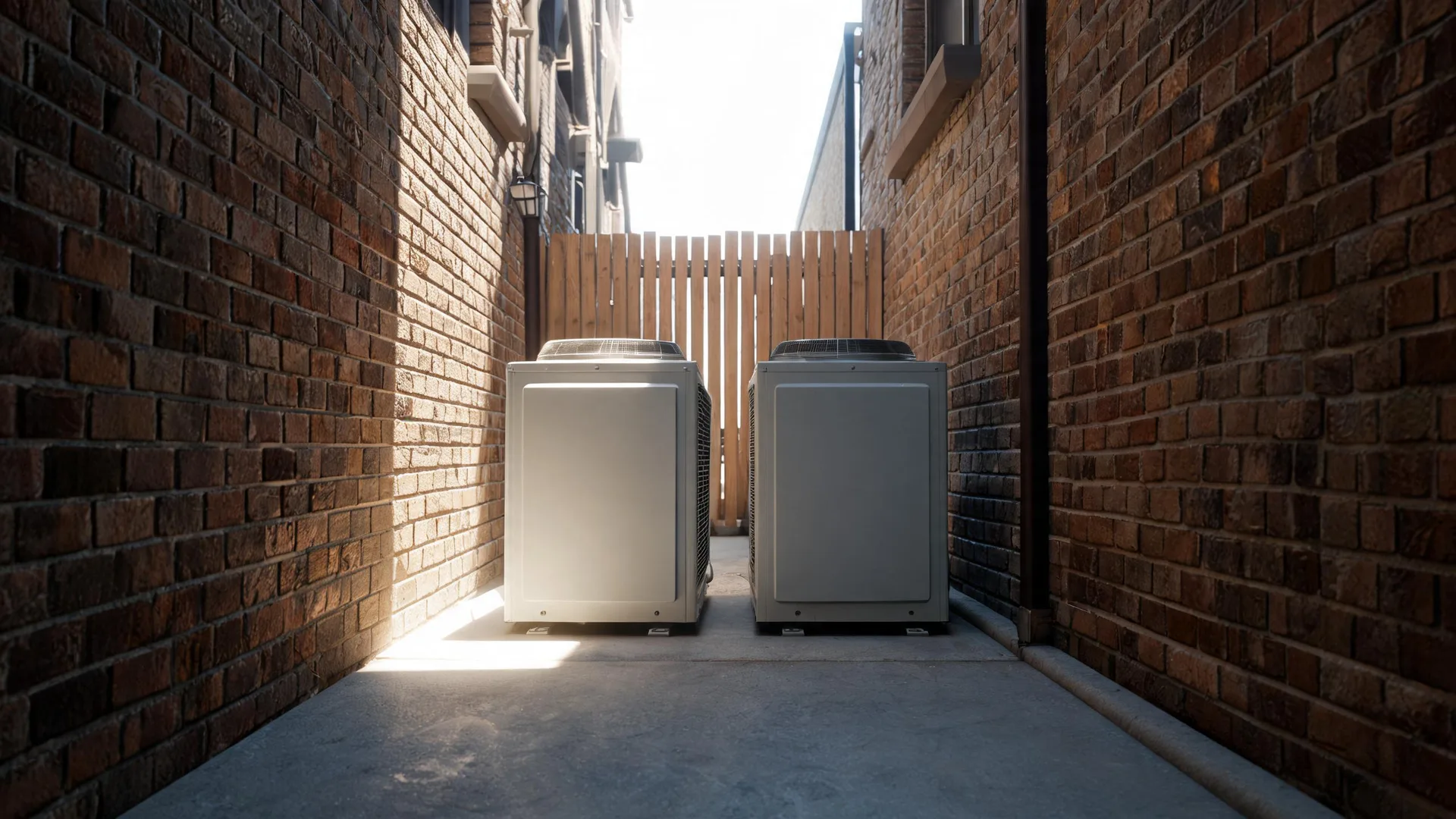
An outdoor heat pump unit mounted on a concrete pad beside a house with beige siding and a landscaped garden bed.

Heat Pump Maintenance in Griffin, GA

Tell us about the job

Takes about a minute. No obligation.

Tune-up, service, or cleaningHeat PumpSpalding County, GA
Step 1 of 2

What ZIP code is the job in?

The refrigerant charge is never obvious from outside

A heat pump low on refrigerant will still blow air and still run, so nothing seems wrong. But the coil underneath can ice over, the compressor works harder than it should, and the system loses its ability to pull heat from cold air or dump heat in summer. A gauge set on the lines is the only way to see this.


A dirty coil hides as a slow decline, not a failure

Dust and grime on the outdoor coil build up so gradually that the drop in output never looks like a problem, it just looks like the system running a little longer each cycle. Left alone, that extra strain on the compressor is what shortens its life.

Heat pumps here switch over and start earning their keep in May and November, the first months of each season.

April and October are when a Griffin heat pump should get checked, right before it has to carry the load.

Half the homes in Spalding County were built by 1985, which means half were built after. A newer heat pump still deserves a yearly check

Half the homes here were built by 1985
89 damaging wind events from 2015 to 2024
Power costs 14.08 cents a kWh statewide

Keep a newer system working like one

A heat pump that's held up fine since it went in can still lose refrigerant or build up grime on the coil without showing it. A yearly check catches that early, while the system has years ahead of it.

Find a contractor
A gray outdoor HVAC unit mounted on a concrete pad beside a house with gray lap siding and a stone foundation.

What a real check actually covers

A quick tune-up checks that the heat pump turns on, blows air, and responds to the thermostat. That tells you almost nothing. A thorough one puts gauges on the lines and checks the refrigerant charge against what the system is supposed to hold. It measures the temperature split across the indoor coil, tests the capacitor under load instead of just eyeballing it, and inspects the reversing valve, the part that lets the system switch between heating and cooling. That valve does not exist on a plain air conditioner, and it is also one of the first things worth checking, since it wears from switching direction over and over. A tech who only listens for the unit to kick on and feels for air at the vent has not actually looked at any of this. The unit can pass that kind of glance and still be low on charge or losing capacity, running longer each cycle to make up for it.

The outdoor unit and the filter are yours to keep clear

Keep leaves, grass clippings and dryer lint away from the outdoor unit, and leave open space around it so air can pull through. Rinse the coil fins with a hose when they look dusty, from the top down. A pressure washer bends the fins shut, so skip it. Check the indoor filter on a set schedule and swap it when it looks gray. A clogged filter starves the indoor coil of airflow, and that strain works back to the compressor the same way a dirty outdoor coil does.

What's inside the cabinet is not yours to check

Refrigerant charge, the reversing valve, the capacitor under load. None of that is visible or testable without gauges and training. Opening the cabinet to look is also how a wire gets bumped loose or a fin gets bent. The homeowner's job is keeping the outside clear and the filter clean. Everything past that is why the yearly check with gauges on the lines exists.

The drain line is the part nobody thinks about until water shows up somewhere it shouldn't. When the indoor coil pulls moisture out of the air, that water has to go somewhere, and it runs out through a small drain that clogs with algae and dust over time. A clogged drain backs up into the pan, and from there it can overflow into the cabinet or drip down into the ceiling below. Some systems shut themselves off when the pan sensor trips, which is better than the alternative but still leaves a heat pump that won't run until the line is cleared. It has nothing to do with refrigerant or the compressor, but it fails the same quiet way, no noise, no smell, just water where it shouldn't be.

A tune-up also covers the defrost cycle, and that part is easy to miss because a plain air conditioner doesn't have one. In cold weather the outdoor coil can frost over, and the system has to sense that, reverse itself briefly, and melt the frost before going back to heating. A tech checks the defrost control board and the sensor that tells it when to switch, because if that sensor reads wrong, the unit either defrosts when it doesn't need to or never defrosts at all and ices over solid. Worn contactor points are worth a look too, since that's the switch that sends power to the compressor and outdoor fan every time the thermostat calls, and pitted contacts can leave the outdoor unit humming without starting. None of this shows up from across the room. It shows up on a meter, or it doesn't show up until the system quits.